
Catherine (Kate) and Margaret Fox: The Story Behind the Birth of Spiritualism
Catherine (Kate) and Margaret Fox are remembered as the young women at the center of events that gave rise to modern Spiritualism. In 1848, in a small house in Hydesville, New York, they became associated with a form of communication with spirits that would soon spread far beyond their home.
Their story, however, is not only about mysterious phenomena. It is also about two individuals whose lives became shaped by public attention, belief, doubt, and personal struggle. What began as a local disturbance grew into a movement—but for Kate and Margaret, it also became a lifelong burden.
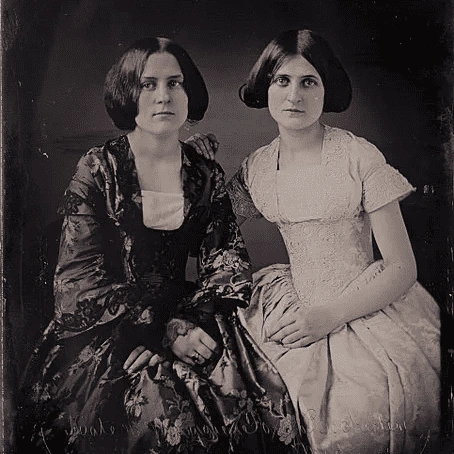
The events in Hydesville
In 1848, the Fox family reported unexplained knocking sounds inside their home. These sounds appeared to respond intelligently to questions, leading the sisters to develop a system of coded communication.
Through a simple method of knocks corresponding to answers or letters, the sisters claimed to interact with an unseen presence. This form of communication later became known as typtology.
What made these events remarkable was not only the phenomenon itself, but how quickly it attracted attention. Neighbors, visitors, and observers came to witness the occurrences, turning a private experience into a public event.
From a small house to a global movement
The Hydesville events marked a turning point. For the first time, spirit communication was presented as something that could be demonstrated, observed, and discussed openly.
Public demonstrations followed, and the idea of communicating with the spirit world spread rapidly. What began with two young sisters soon became a broader movement that would influence both American Spiritualism and later discussions within Spiritism.
At the center of this transformation stood Kate and Margaret, no longer private individuals, but public figures.
Two lives behind one story
Although often grouped together as the “Fox sisters,” Kate and Margaret did not experience their lives in the same way.
Kate was generally perceived as more socially stable and adaptable. Margaret, by contrast, struggled more deeply with the pressures placed upon her. Their roles as mediums brought not only recognition, but also expectation, scrutiny, and emotional strain.
Their story is therefore not only about a phenomenon, but about how two individuals navigated a life shaped by forces they may not have fully controlled.
Struggle, pressure, and public confession
As time passed, the weight of public attention and controversy grew. The sisters faced criticism, skepticism, and personal difficulties, including financial problems and emotional instability.
One of the most dramatic moments came when Margaret publicly declared that the phenomena had been produced artificially. This statement was widely interpreted as a confession of fraud and became a powerful argument for critics.
However, the situation did not remain clear. Margaret later retracted her confession, claiming it had been made under pressure and in difficult circumstances. This reversal left the story unresolved and continues to fuel debate to this day.
Interpretation and significance
The importance of Kate and Margaret Fox does not depend solely on whether the original phenomena were genuine or not. Their true significance lies in what followed.
They transformed isolated experiences into a social reality. They brought the idea of communication with spirits into public awareness and made it accessible in a way that had not existed before.
In doing so, they helped create the conditions in which later thinkers, including Allan Kardec, could approach similar questions with greater structure and philosophical depth.
Critical perspective
The Fox sisters remain one of the most debated cases in the history of spiritual phenomena. For some, they represent the beginning of a genuine exploration of the unseen. For others, they illustrate how belief, expectation, and human factors can produce convincing but misleading results.
From a Spiritist perspective, their story highlights the importance of discernment and the need to evaluate the quality of spirit communications. Not every phenomenon should be accepted at face value, and moral seriousness remains essential.
Why their story still matters
The story of Kate and Margaret Fox still matters because it stands at the beginning of a modern conversation about the afterlife and the possibility of communication beyond death.
It is a story that combines mystery, belief, doubt, and human vulnerability. More than a simple historical episode, it reflects how people respond to the unknown—and how the search for meaning can shape both movements and individual lives.