
Allan Kardec: Life, Spiritism, Method and Legacy
Allan Kardec, born Hippolyte Léon Denizard Rivail, was a French educator, translator, writer and the codifier of Spiritism. His work gave structure to a doctrine that studies spirits, mediumship, reincarnation, moral progress and life after death through observation, comparison and reason.
Kardec did not begin as a mystic, prophet or visionary. Before adopting the name Allan Kardec, he was known as Professor Rivail: a disciplined educator formed by the method of Johann Heinrich Pestalozzi, by the intellectual culture of nineteenth-century France and by a lifelong concern for moral and intellectual education.
His importance lies in a rare combination: the discipline of a teacher, the caution of an investigator and the moral ambition of a reformer. He tried to interpret spirit phenomena without reducing them to superstition, spectacle or blind belief.
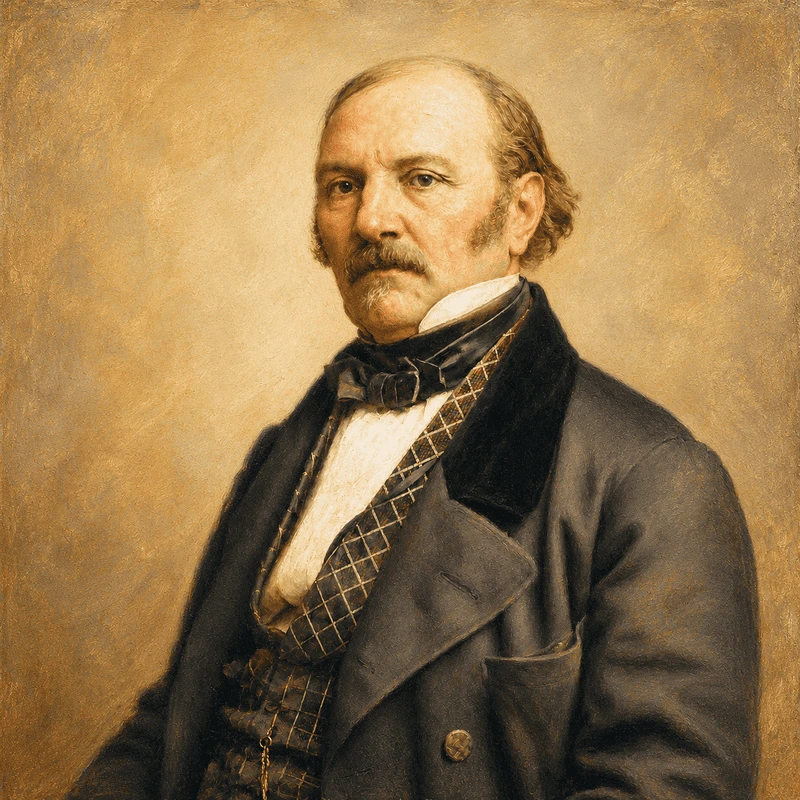

Who was Allan Kardec?
Allan Kardec was the pen name of Hippolyte Léon Denizard Rivail, a nineteenth-century French educator who became one of the most influential figures in the history of modern spiritual thought. He is best known for organizing and publishing the teachings that formed the foundation of Spiritism.
Kardec is best understood in two connected lives. The first is the life of Professor Rivail: the teacher, educational reformer, author of pedagogical works and student of Pestalozzi’s method. The second is the life of Allan Kardec: the codifier of Spiritism, the editor of Revue Spirite, the organizer of mediumistic communications and the author of the works that became the Spiritist Codification.
His importance lies not only in the ideas he defended, but also in the way he tried to study them. Kardec approached spirit phenomena as a subject requiring method, caution and moral seriousness. He rejected both blind belief and careless denial. His goal was to understand whether the phenomena reported through mediumship revealed real laws concerning the soul, the afterlife and the relationship between the visible and invisible worlds.
This gave Spiritism a distinctive identity. It was not only a collection of séances, mysterious events or personal revelations. Kardec presented it as a philosophical and moral doctrine based on the existence of spirits, the survival of the soul, the plurality of existences and the gradual progress of all beings.
He also remains important because his work stands at the crossing point of several nineteenth-century worlds: education, Catholic culture, Protestant influence, secular reason, magnetism, early psychology, popular spiritual phenomena, publishing and the growing desire to reconcile science and religion.
Before Spiritism
Professor Rivail
Hippolyte Léon Denizard Rivail was an educator, translator and author of pedagogical works. His formation was shaped by Pestalozzi’s method, public instruction, scientific curiosity and moral education.
After 1857
Allan Kardec
Allan Kardec became the codifier of Spiritism: the organizer of spirit communications, editor of Revue Spirite and author of the works that formed the Spiritist Codification.
Key ideas to understand this profile
These terms appear throughout Kardec’s life and work. Open them for a quick explanation before reading the full profile.
Spiritism
Spiritism is the doctrine codified by Allan Kardec. It studies spirits, the survival of the soul, reincarnation, mediumship, moral progress and life after death through reason, observation and moral reflection.
Mediumship
Mediumship is the faculty through which a person may serve as an intermediary between spirits and the material world. Kardec insisted that mediumship requires discernment, caution and moral responsibility.
Perispirit
The perispirit is the subtle envelope of the spirit. In Kardec’s doctrine, it links the spirit to the physical body during life and remains with the spirit after death.
Reincarnation
Reincarnation is central to Spiritism. It explains spiritual progress across many lives, allowing the spirit to learn, repair, develop and advance morally.
Universal control
Kardec did not want doctrine to depend on one medium or one message. He compared communications from different sources and accepted teachings only when they showed broader agreement, reason and moral elevation.
Spiritist Codification
The Spiritist Codification is the group of Kardec’s main works, especially The Spirits’ Book, The Mediums’ Book, The Gospel According to Spiritism, Heaven and Hell and Genesis.
Timeline of Allan Kardec’s life
This timeline highlights the main stages of Allan Kardec’s life: his formation as Hippolyte Léon Denizard Rivail, his work as an educator, his encounter with spirit phenomena and the publication of the works that shaped Spiritism.
Summary: Kardec’s Spiritist work grew out of decades of education, translation, public teaching, rational inquiry and moral concern.
Family background and birth in Lyon
Hippolyte Léon Denizard Rivail was born in Lyon, France, on 3 October 1804. Lyon was not only a geographical detail in his biography. It was a major urban, commercial and intellectual center, and later Spiritist memory often emphasized that the future codifier of Spiritism came from a city with a strong historical and moral identity.
Biographical tradition places him within an old Lyon family named Rivail. His father, Jean-Baptiste Antoine Rivail, is described in official records and later biographies as a magistrate and judge. His mother was Jeanne Duhamel. Sausse’s biography also preserves the address connected with the birth record: Rue Sala, Lyon.
This family background matters because Rivail did not emerge from a marginal or anti-intellectual environment. He was born into a family associated with law, public seriousness and social respectability. Several biographical sources emphasize that the Rivail family had been connected with law and magistracy for generations.
One might therefore have expected the young Rivail to follow a legal career. Instead, from youth he was drawn toward science, philosophy, education and the intellectual formation of the human being. This early turn away from the expected family path is one of the first signs of the independence that would later characterize his work.
Context: Kardec’s later method did not come out of nowhere. His public seriousness, love of order and concern with moral law can be better understood when seen against the background of a family culture connected with legal responsibility and disciplined civic life.
Childhood and early intellectual formation
Details about Rivail’s childhood are limited, and responsible biography should not invent what the sources do not preserve. What can be said with confidence is that his early formation took place in a family and social environment that valued education, respectability and intellectual discipline.
Later biographers emphasize that he showed an early attraction to the sciences and philosophy. This corrects a common misunderstanding: Kardec did not become an intellectual through Spiritism. He was already intellectually formed long before he encountered mediumistic phenomena.
His early years also placed him inside a France still deeply marked by Catholic culture, post-revolutionary transformation and debates about education. He was born only a few years after the French Revolution and during the Napoleonic period. The question of how to educate citizens, how to reconcile reason and morality, and how to renew society was not abstract. It belonged to the atmosphere of his century.
It helps explain why education remained central to his later work. Even when writing about spirits, reincarnation, the afterlife or mediumship, Kardec wrote like a teacher. His books define terms, classify ideas, ask questions, compare answers and try to move the reader gradually from curiosity to understanding.
Pestalozzi’s Institute at Yverdon
Rivail’s education at the institute of Johann Heinrich Pestalozzi in Yverdon, Switzerland, was one of the decisive influences of his life. Pestalozzi was one of the important educational reformers of the period. His method emphasized observation, active learning, moral development and the harmonious education of the whole person.
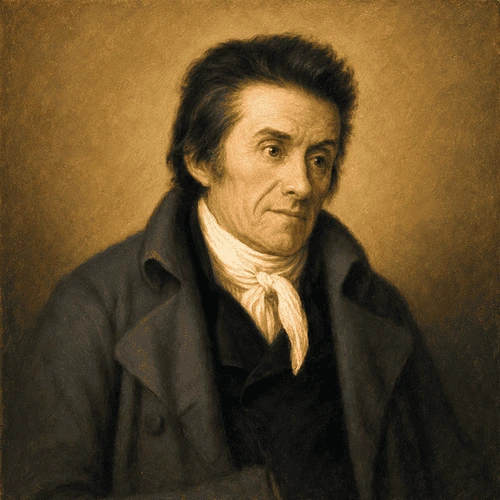
Johann Heinrich Pestalozzi
Johann Heinrich Pestalozzi was a Swiss educational reformer whose method deeply shaped Rivail’s formation as a teacher. His emphasis on observation, moral education and the gradual development of the whole person later echoed in Kardec’s disciplined and pedagogical approach to Spiritism.
At Yverdon, Rivail encountered an educational environment very different from rigid rote learning. Pestalozzi’s method aimed to develop intelligence, character, practical judgment and moral feeling. It emphasized observation, self-activity and the gradual discovery of laws through experience rather than mere punishment or passive memorization.
The influence appears later in Kardec’s Spiritist writings, which often move from definitions to consequences. The same educational instinct appears in his rejection of blind belief: readers are invited to examine, compare and understand spiritual laws rather than accept them only by authority.
Biographical sources portray Rivail as more than an ordinary pupil. He became one of Pestalozzi’s notable disciples and collaborators. When Pestalozzi was called away to advise or establish educational institutions elsewhere, Rivail is said to have helped in the direction of the school. This suggests that even as a young man he was trusted for his discipline, intelligence and pedagogical ability.
Some biographical accounts also emphasize his early passion for teaching. He reportedly helped less advanced schoolmates and showed a strong inclination toward instruction from a young age. The detail is not incidental. It reveals the continuity between Rivail the student, Rivail the teacher and Kardec the codifier.
Pestalozzi’s influence can also be seen in Kardec’s tone. He rarely presents doctrine as emotional proclamation. He organizes it pedagogically. The Spirits’ Book, for example, is built through questions and answers; it teaches the reader how to approach the subject, not only what to conclude.
Summary: The future Allan Kardec was shaped first by educational reform, not by séances. Pestalozzi gave him a model of ordered instruction, moral seriousness and confidence in human improvement.
Catholic France, Protestant Switzerland and freedom of thought
Rivail was born in Catholic France but educated in a Protestant Swiss environment. This contrast was important. It exposed him early to religious difference and to the need for moral truth beyond sectarian boundaries.
Some biographical accounts state that, while still young, he began reflecting on the possibility of unity among Christian groups. This early concern would later reappear in a different form in Spiritism. Kardec did not present Spiritism as a new sect competing with old ones. He presented it as a philosophical and moral doctrine capable of clarifying spiritual laws through reason and observation.
This background also helps explain his later attitude toward religious dogma. Kardec treated the moral teachings of Jesus with deep respect, but he resisted doctrines that he believed contradicted reason, divine justice or moral progress. His critique of eternal punishment, miracles as violations of natural law and exclusive ecclesiastical authority was rooted in this broader desire for a rational and universal spiritual truth.
In this sense, his education across Catholic and Protestant contexts helped form a mind that was spiritual but not narrowly confessional, religiously serious but resistant to dogmatic closure.
The nineteenth-century context
Kardec’s thought belongs to the crowded intellectual world of nineteenth-century France. He lived in a period shaped by Catholic tradition, post-revolutionary politics, educational reform, secular reason, socialism, scientific ambition, magnetism and growing doubts about materialism.
Several currents formed the atmosphere around him. Saint-Simonian and utopian socialist ideas were circulating in Paris, raising questions about moral progress, social organization and the future of humanity. Kardec did not become a socialist theorist, but his Spiritism shared the century’s concern with progress, education and the moral improvement of society.
Auguste Comte’s positivism also belongs to this context. Kardec did not accept a purely materialist or anti-metaphysical worldview, but he shared the desire for order, method and law. His disagreement with materialism did not lead him to reject reason. Instead, he argued that spiritual phenomena, if real, should be studied as part of nature rather than treated as supernatural exceptions.
Magnetism and somnambulism were especially important bridges. Long before Kardec’s mature Spiritist work, figures such as Mesmer, Puységur and later magnetic practitioners had popularized debates about trance, clairvoyance, healing, invisible influence and hidden faculties of the human being. Kardec inherited this vocabulary, but gave it a different interpretation by arguing that some communications came from discarnate spirits rather than only from the living mind.
This context helps explain Kardec’s unusual position. He was neither a conventional church theologian nor a materialist philosopher. He tried to occupy a third space: spiritual, rational, moral and observational.
Professor Rivail before Spiritism
Before he became known as Allan Kardec, Rivail spent decades as a teacher, translator and author of educational works. His first public identity was not that of a religious reformer or spiritual leader. It was that of a pedagogue.
After his studies, he worked in Paris in educational circles and became known as a man of learning. He translated, wrote, taught and organized courses. His range of subjects was broad: grammar, arithmetic, mathematics, physics, chemistry, astronomy, physiology, anatomy and moral instruction.
This matters because his Spiritist work bears the mark of the classroom. Kardec’s books are full of questions, definitions, classifications and warnings against confusion. He wanted to instruct, not only impress. He wanted to lead the reader through a structured path of understanding.
According to biographical sources, Rivail was also connected with several learned societies. He received recognition from the Royal Academy of Arras for work related to education. This kind of recognition helped establish his credibility before the Spiritist period.
His later role as Kardec cannot be understood without this earlier life. The codifier of Spiritism was first a teacher. The organizer of spirit communications was first a man trained to organize knowledge.
Pedagogical works
Rivail’s pre-Spiritist writings are an essential part of his intellectual profile. They show that he was already a published author and educator before his name became associated with Spiritism.
Works attributed to his pedagogical period include:
- Cours pratique et théorique d’arithmétique: a practical and theoretical course in arithmetic, connected with Pestalozzi’s educational method.
- Plan proposé pour l’amélioration de l’instruction publique: a proposal for improving public instruction and the organization of education.
- Grammaire française classique: a work connected with French grammar and language instruction.
- Manuel des examens pour les brevets de capacité: a manual related to examinations, arithmetic and geometry.
- Catéchisme grammatical de la langue française: a grammatical work attributed to Rivail in biographical sources.
- Other educational manuals and teaching materials: works connected with language, arithmetic, science, public instruction and moral education.
These works are important because they correct a common misunderstanding. Kardec was not an obscure mystic who suddenly became famous through séances. He was already a trained educator and published author. His Spiritist works grew out of a mind accustomed to pedagogy, classification and public instruction.
The form of The Spirits’ Book reflects this background. Its question-and-answer structure resembles a teaching method. It proceeds gradually, defining ideas before developing consequences. This pedagogical structure is one of the reasons the book could become not only a spiritual text, but also a manual of doctrine.
Free public courses
One of the strongest signs of Rivail’s educational vocation is his involvement in public instruction beyond ordinary professional teaching. Biographical accounts describe him organizing free courses in subjects such as chemistry, physics, astronomy and comparative anatomy.
This detail shows that his idea of mission did not begin only with Spiritism. Long before The Spirits’ Book, Rivail had already linked knowledge with service. Education was not only a profession; it was a way to improve individuals and society.
The subjects he taught also reveal the breadth of his interests. He was not confined to grammar or religious instruction. He moved across scientific and humanistic fields, which later helped him approach Spiritist phenomena in a language of law, observation and classification.
In a nineteenth-century context, free public courses also had a social meaning. They opened knowledge to people who might not otherwise have access to it. This concern with accessibility later reappeared in Kardec’s desire to make Spiritism understandable through books, periodicals, dialogues and clear explanations.
Amélie Gabrielle Boudet
In 1832, Rivail married Amélie Gabrielle Boudet, a teacher and woman of culture. She was born in 1795 and was therefore older than Rivail, but biographical accounts often note that she appeared younger than her age and was remembered as intelligent, lively and gracious.
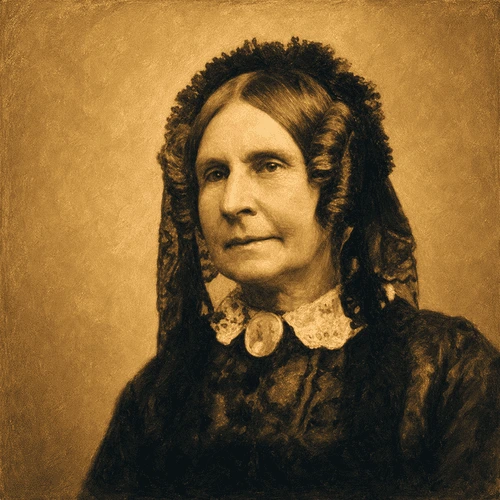
Amélie Gabrielle Boudet
Amélie Gabrielle Boudet was Kardec’s wife, an educated woman and a loyal supporter of his public mission. Her role became especially important after Kardec’s death, when the preservation of his work and the continuity of the Spiritist movement depended on practical dedication as much as public authorship.
Amélie came from an educated background. Her father, Julien-Louis Boudet, is described as a proprietor and former notary. She was not only the wife of a public man; she was herself an educated woman, associated with teaching, literature and the arts.
Her role should not be reduced to that of a passive spouse. She accompanied Kardec through the most demanding years of his Spiritist work and helped preserve his legacy after his death. Their relationship is often remembered as one of intellectual companionship, loyalty and moral support.
Several biographical accounts emphasize that Amélie’s support allowed Kardec to devote himself more fully to his work. She helped create the conditions in which he could write, edit, correspond, receive visitors and maintain the heavy burden of the Spiritist movement.
Her importance increased after Kardec’s death. She helped maintain the continuity of the movement and the memory of his work, including the preservation and administration of Spiritist publishing activity. Without her support and commitment, the early Spiritist legacy might have been far more fragile.
After 1869, Amélie also had to protect Kardec’s name during a difficult period of institutional transition. The movement needed continuity, but it also faced internal tensions, disputes over direction and the practical burden of publishing, correspondence and public reputation. Her role was therefore not only sentimental. She was part of the bridge between Kardec’s personal leadership and the later organization of the Spiritist movement.
Her place in Spiritist history has often been underestimated because the public authorship belonged to Kardec. Yet the survival of a doctrine depends not only on books, but on people who preserve archives, maintain institutions, defend reputations and keep a movement organized after its founder dies.
Historical context: Amélie Boudet was part of the practical foundation of Kardec’s work. A complete profile of Allan Kardec should not erase the woman who helped sustain his intellectual and public mission.
Women were also central to the early development of Spiritism more broadly. The Baudin sisters, Célina Japhet and other female mediums were involved in the communications and circles through which Kardec studied, compared and organized early material. Their role should be remembered carefully: Kardec became the public codifier, but much of the early mediumistic environment depended on women whose names are often treated as secondary in later histories.
Financial crisis and disciplined work
A complete portrait of Kardec must include his difficulties. Rivail did not enter Spiritism as a young prophet or as a professor at the height of an uninterrupted career. By the time he seriously encountered spirit phenomena in the 1850s, he was already in his early fifties and had lived through professional and financial instability.
Biographical sources describe a difficult financial episode connected with his educational enterprise. A partner associated with the project is said to have been ruined by gambling, and Rivail’s educational institution was affected. Later, funds entrusted to a business acquaintance were reportedly lost in bankruptcy.
Far from abandoning work, Rivail and Amélie responded with discipline. He took on accounting work, continued writing educational materials, prepared courses and translated works. This period shows the practical resilience behind the later image of Kardec as a tireless worker.
It gives his biography a more human dimension. Kardec’s Spiritist work emerged from a mature phase marked by responsibility, pressure and perseverance. He was not only the “future codifier” waiting for a mission. He was a working educator who knew uncertainty, fatigue and the need to rebuild life through disciplined labor.
Personal portrait: the man behind the codifier
Several later descriptions portray Kardec as a man whose outward manner contrasted strongly with the extraordinary subject he studied. He was not typically described as ecstatic, theatrical or mystical. On the contrary, he was remembered as calm, disciplined, sober and analytical.
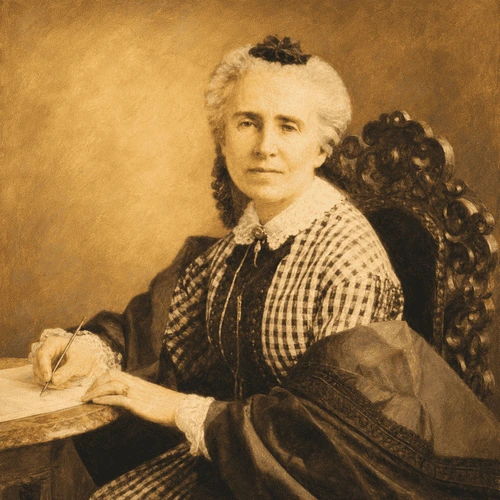
Anna Blackwell, one of the important English translators and interpreters of Kardec’s work, described him as a man of solid build, with marked features and clear grey eyes. She also emphasized the seriousness of his temperament and the absence of mystical extravagance in his manner.
Other descriptions remember him as grave, slow in speech, unassuming and dignified. He did not constantly introduce Spiritism into conversation, but when serious visitors came to discuss it, he answered questions, explained difficulties and provided information patiently.
Kardec’s authority did not rest on theatrical charisma. He did not present himself as a prophet in trance or as a wonder-worker. He appeared more like a rigorous professor: careful, restrained, methodical and sometimes severe.
That contrast helps explain his influence. He approached a subject often associated with emotion, fear or fascination with the habits of an educator and organizer. For admirers, this gave Spiritism credibility. For critics, it sometimes made him appear rigid or overly confident in his system.
Daily life, visitors and correspondence
Kardec’s work was not limited to writing books. He received visitors, answered letters, directed a periodical, attended meetings, organized doctrinal material and responded to critics. His life became increasingly absorbed by the movement that formed around his work.
Biographical sources describe a man who made few social visits outside a small circle, but who received many visitors from France and abroad. These visitors included ordinary readers, serious inquirers, members of Spiritist groups, professionals and people from literary, scientific and social elites.
His routine was demanding. In later years, he was responsible not only for writing and editing, but also for the practical organization of Spiritism as a movement. He handled letters, polemics, reports of phenomena, doctrinal questions and plans for future institutions.
This heavy workload helps explain why the final years of his life were marked by exhaustion. Spiritist biographies often emphasize his iron will and tireless dedication, but the same dedication also placed great strain on his health.
Languages, translation and terminology
Kardec wrote his Spiritist works in French, but his intellectual formation was not limited to one language. Biographical sources describe him as fluent in German and English, with knowledge of Dutch. This linguistic background mattered because he lived between French educational culture, Swiss Protestant influence and the broader European exchange of ideas.
Language also matters for understanding Spiritism itself. Kardec deliberately used the French term spiritisme to distinguish his doctrine from broader spiritualist currents. In English, this distinction can be confusing because “Spiritualism” often refers to the wider Anglo-American movement of communication with the dead, while “Spiritism” usually refers to Kardec’s codified doctrine.
Several key terms are difficult to translate without losing nuance. The French word esprit can mean spirit, mind or intelligent principle depending on context. Périsprit became “perispirit,” a technical term for the semi-material envelope of the spirit. Réincarnation, which Kardec helped place at the center of his doctrine, became one of the clearest points separating Spiritism from many forms of English-language Spiritualism.
For this reason translation is not a minor detail in Kardec’s legacy. His influence spread through books, editions and terminology, and each language had to decide how to carry concepts that were both philosophical and religious, technical and moral.
Magnetism before Spiritism
Spiritism did not arise in an intellectual vacuum. Before Kardec became involved with spirit communications, European culture had already been shaped by mesmerism, animal magnetism, somnambulism and debates about hidden forces in nature.
Rivail was reportedly interested in magnetism long before his formal involvement with Spiritism. This matters because many of the phenomena later discussed by Kardec — trance, clairvoyance, altered perception, healing, influence at a distance and the relationship between body and soul — were already being debated in magnetic circles.
One of the first people to speak to him about the turning tables was Mr. Fortier, a magnetizer. Fortier reportedly told him not only that tables could turn, but that they could also respond intelligently. Rivail’s first reaction was skeptical. He did not accept the claim simply because someone reported it.
For Kardec, magnetism helped open a path between strict materialism and traditional religion. It suggested that the human being might include dimensions not fully explained by ordinary physiology. Spiritism would later extend this field by arguing that some phenomena were not only produced by the living mind, but by discarnate intelligences.
This connection also explains why Kardec often used the language of fluids, influence, transmission and subtle action. His concept of the universal fluid and his explanations of the perispirit belong to this wider nineteenth-century world of magnetism, physiology and spiritual philosophy.
First contact with spirit phenomena
In the 1850s, Europe was fascinated by table-turning, raps and other physical phenomena associated with the movement then known as Modern Spiritualism. These manifestations had become widely discussed after the events connected with the Fox sisters in the United States and then spread into European salons and intellectual circles.
Fortier and the first report of turning tables
Rivail first heard of turning tables in 1854. His initial reaction was skeptical. When told that tables could not only move but also “speak” by giving intelligent responses, he did not accept the claim easily. His reported reaction was that he would believe it only when it was proven to him that a table had a brain, nerves and the ability to enter a state comparable to somnambulism.
Carlotti and the idea of spirit intervention
Another early influence was Mr. Carlotti, a friend who spoke to Rivail enthusiastically about the possible intervention of spirits. Rivail listened, but he did not allow enthusiasm to replace evidence. Carlotti’s confidence seems to have increased Rivail’s curiosity, but also his caution.
Madame de Plainemaison and first direct observations
In 1855, Rivail was invited to observe phenomena more directly in the circle of Madame de Plainemaison. There he witnessed table movements under conditions that, according to later accounts, made doubt more difficult. He also saw early attempts at mediumistic writing.
These observations did not instantly make him a believer. Instead, they convinced him that there was a fact requiring investigation. Beneath what many treated as salon amusement, he perceived the possibility of a serious law.
The Baudin family and systematic study
A decisive stage came through the Baudin family. At their home, Rivail began attending sessions more regularly and studying communications obtained through young mediums. The Baudin sisters became important in the early development of The Spirits’ Book.
What changed at this point was the purpose of the meetings. Rivail began bringing prepared questions. Instead of allowing the sessions to remain casual or playful, he turned them into occasions for systematic inquiry.
The techniques of communication also evolved. Early séances often involved physical effects such as table movements and raps. Later, devices such as baskets or small mechanisms fitted with pencils were used before more direct forms of writing became common. This transition from physical phenomena to written communications mattered for Kardec, because written answers allowed comparison, revision and doctrinal organization.
Célina Japhet and the revision of early material
Another name associated with the early preparation of the doctrine is Célina Japhet, a somnambulist and medium mentioned in connection with the analysis and revision of material that would contribute to the first edition of The Spirits’ Book.
These names make clear that the codification did not arise in isolation. It was produced through a network of mediums, observers, correspondents and collaborators. Kardec’s role was not to invent the messages, but to question, compare, classify and organize them.
Kardec’s later belief in communication with spirits did not begin as simple credulity. He approached the subject first as a problem of interpretation: if the effects were real, what caused them, and if the answers were intelligent, what was the source of that intelligence?
Why he used the name Allan Kardec
The name Allan Kardec was not Rivail’s birth name. According to Spiritist tradition, the name was communicated through a spirit who stated that Rivail had borne it in a previous incarnation as a druid in ancient Gaul.
Some accounts identify this communicating spirit as Zefir or Zephyr. The name connected Rivail’s new spiritual mission with an ancient, Celtic and druidic past. Whether one accepts this claim literally or symbolically, it became central to the public identity of the codifier.
Kardec adopted this name for his Spiritist works. This helped distinguish his new role as codifier of Spiritism from his earlier career as Professor Rivail, educator and author of pedagogical writings.
For a modern reader, this should be presented with care. The druidic origin of the name belongs to Spiritist tradition and to Kardec’s own spiritual context. It is not a conventional historical claim that can be verified in the same way as a birth record or publication date. Still, the name became historically decisive: “Allan Kardec” became the identity under which Rivail’s Spiritist works spread across the world.
The making of The Spirits’ Book
The Spirits’ Book was not produced as a single ecstatic revelation. It emerged from a process of questions, communications, notebooks, comparison, revision and editorial organization.
Before publication, Rivail received or examined communications obtained through different mediums. He prepared questions on God, the soul, spirits, moral law, free will, reincarnation, the afterlife, suffering and human destiny. These questions were submitted in séances, and the answers were then compared, arranged and developed.
The work also drew from notebooks of communications gathered by people who had been observing spirit phenomena before Rivail became fully involved. His role was to bring order to scattered material. He removed repetitions, identified missing points, clarified obscure passages and prepared further questions.
For this reason Spiritists often call him the codifier rather than simply the author of Spiritism. His contribution was not only literary. It was methodological and organizational. He turned scattered messages and phenomena into a structured doctrine.
The first edition of The Spirits’ Book appeared on 18 April 1857. Later, the work was revised and expanded into the better-known form containing 1,019 questions and answers. It became the backbone of Kardecist Spiritism.
The book was successful quickly. It helped transform the name Allan Kardec into the public identity of the movement and gave Spiritism a foundation that could be studied, debated, translated and transmitted beyond individual séances.
Why Kardec was not mainly a medium
One of the important points about Kardec is that he was not primarily known as a medium. He was a researcher, compiler, editor, critic and codifier. The distinction is important.
If Spiritism had depended only on Kardec’s personal mediumship, critics could have dismissed it as the product of one person’s imagination. Instead, Kardec presented himself as someone who collected, compared and organized communications obtained through many mediums.
He studied answers received through different people, in different places and under different conditions. This gave his work a methodological shield: the doctrine was not supposed to rest on one trance, one séance, one personality or one emotional experience.
This does not mean that his conclusions are beyond criticism. It means that his project was structurally different from the work of a single visionary. Kardec’s claim was not “believe me because I saw.” It was closer to: examine the communications, compare them, judge their moral and rational quality, and see whether a coherent law emerges.
His method of investigation
Kardec’s central contribution was not that he attended séances. Many people did. What made him important was that he tried to organize the material systematically.
He prepared questions on God, the soul, spirits, moral law, reincarnation, suffering, free will and the afterlife. These questions were submitted through different mediums and in different contexts. Kardec then compared the answers, rejected what seemed contradictory or morally inferior, and looked for convergence.
This comparative procedure became one of the foundations of the Spiritist method. Kardec did not want a doctrine based on one medium, one group, one revelation or one isolated phenomenon. He sought what he understood as a broader agreement among independent communications.
His method included several principles:
- Do not accept a spirit communication merely because it claims to come from a high source.
- Judge communications by their clarity, coherence and moral elevation.
- Compare messages received through different mediums.
- Reject blind credulity and uncontrolled enthusiasm.
- Distinguish serious study from curiosity, spectacle or entertainment.
- Look for natural laws behind phenomena that appear extraordinary.
For this reason Kardec repeatedly warned against unreliable spirits, deception, obsession and the dangers of vanity in mediumistic practice. For him, the quality of spirit communications mattered more than their dramatic form.
Universal control of spirit teachings
Kardec’s method is often summarized by the idea sometimes called the “universal control of the teachings of the spirits.” The principle is simple but powerful: no teaching should be accepted merely because one spirit, one medium or one group affirms it.
Instead, Kardec looked for agreement among communications received through different mediums, especially when those mediums did not know one another. He believed that serious doctrinal points should be supported by a wider convergence of messages, not by isolated claims.
This method was not identical to modern laboratory science, but it does resemble what today might be called triangulation: comparing multiple sources, looking for patterns, checking consistency and separating repeated principles from local noise.
For Kardec, a fact was not the same as a doctrine. A phenomenon might occur, but its meaning still had to be interpreted. A spirit might communicate, but that spirit might be limited, mistaken or deceptive. A doctrine could only emerge after comparison, criticism and moral evaluation.
He also separated three levels that are often confused: the phenomenon itself, the interpretation given by a spirit or medium, and the doctrinal conclusion drawn from comparison. This distinction is one reason his work still attracts interest from historians of religion, psychology and psychical research.
Strengths and limits of Kardec’s method
Kardec’s method was strong because it did not rest on a single medium or a single extraordinary event. He compared communications, looked for consistency and insisted that messages should be judged by reason and moral elevation. For a nineteenth-century religious movement, this was a serious attempt to introduce discipline into a field often marked by enthusiasm and credulity.
His idea of truth was not purely empirical in the modern laboratory sense, nor purely theological in the traditional sense. He looked for three kinds of confirmation: repeated testimony, logical coherence and moral elevation. A communication could be impressive and still be rejected if it appeared frivolous, contradictory, arrogant or incompatible with what he considered divine justice.
This placed Kardec between several worlds. He differed from mesmerists by interpreting some phenomena as the action of discarnate intelligences, from Swedenborg by building a comparative doctrine rather than a visionary cosmology, from Catholic theology by rejecting fixed dogma and eternal punishment, and from positivist materialism by refusing to reduce the human being to the physical organism.
At the same time, a modern reader should recognize the limits of his method. The comparison of mediumistic messages is not the same as controlled laboratory verification. Kardec’s criteria included moral and philosophical judgment, not only external measurement. This means that his conclusions were shaped partly by what he considered rational, elevated and compatible with divine justice.
One possible modern criticism is the risk of confirmation bias: the tendency to give more weight to communications that confirmed the emerging doctrine and less weight to those that contradicted it. Kardec was aware of deception and contradiction among spirits, but critics may still ask whether his system sometimes filtered the evidence through the doctrine it was building.
Kardec’s method is therefore better understood as a nineteenth-century comparative spiritual philosophy than as laboratory science in the modern sense. It was based on communications, moral reasoning, repeated reports and the conviction that spiritual truth must be coherent with justice, progress and reason.
The birth of Spiritism
The first edition of The Spirits’ Book was published on 18 April 1857. It marked the formal beginning of Spiritism as a codified doctrine. The book was structured as questions and answers, dealing with the nature of God, spirits, the spiritual world, moral laws, human destiny and the future life.
With The Spirits’ Book, Rivail became Allan Kardec. The work transformed scattered phenomena into an organized philosophical system. It argued that spirits are the souls of human beings who have lived before, that the soul survives death, that spirits progress through multiple existences, and that moral growth is the true purpose of life.
In 1858, Kardec launched Revue Spirite, the Spiritist Review, a periodical devoted to the study of psychological and spirit phenomena. In the same year, he helped found the Parisian Society for Spiritist Studies, creating a more formal environment for discussion, observation and doctrinal development.
In 1859, Kardec published What Is Spiritism? (Qu’est-ce que le Spiritisme?). This work deserves special attention because it served as a concise and accessible introduction to the doctrine. It was also a response to critics, misunderstandings and common objections. For many readers, it remains one of the easiest entry points into Kardec’s thought.
Revue Spirite and the Parisian Society for Spiritist Studies
Revue Spirite, launched on 1 January 1858, became one of Kardec’s important tools. It was not only a magazine. It was a public laboratory of Spiritist thought.
Through the periodical, Kardec could publish reports, answer objections, examine communications, discuss doctrinal questions and connect isolated groups into a broader movement. It allowed Spiritism to move beyond private séances and enter the public world of reading, debate and correspondence.
The Parisian Society for Spiritist Studies, founded in 1858, gave the movement a more organized setting. The society gathered people interested in serious study and provided a framework for observation, discussion and mediumistic communications.
Kardec repeatedly insisted that Spiritism should not be reduced to entertainment. Meetings had to be serious, disciplined and morally oriented. This insistence distinguished his project from the lighter salon culture of table-turning, which had often treated spirit phenomena as a curiosity.
Together, Revue Spirite and the Parisian Society helped turn Spiritism into a movement with a doctrine, a literature, a network and a method of study.
The Spiritist Codification
Kardec’s major Spiritist works are often called the Spiritist Codification. They form the doctrinal foundation of Kardecist Spiritism.
- The Spirits’ Book (1857): The foundational work of Spiritism, dealing with God, spirits, the soul, moral law, reincarnation, death and the afterlife. Read the PDF at the International Spiritist Council.
- The Mediums’ Book (1861): A practical and theoretical guide to mediumship and spirit communication, types of mediums, spiritual influence and the dangers of deception. Read the PDF at the International Spiritist Council.
- The Gospel According to Spiritism (1864): A moral interpretation of the teachings of Jesus, especially in relation to charity, humility, forgiveness and spiritual progress. Read the PDF at the International Spiritist Council.
- Heaven and Hell (1865): A study of divine justice, the condition of the soul after death, suffering, remorse and the future life. Read the PDF at the International Spiritist Council.
- Genesis (1868): A work on creation, miracles, predictions and the relationship between spiritual law and natural law. Read the PDF at the International Spiritist Council.
Together, these works explain what spirits are, but also how reincarnation, moral responsibility, mediumship and spiritual evolution fit into a larger order.
The codification also shows Kardec’s gradual method. Spiritism was not presented all at once. It developed through successive works, each addressing a different aspect of the doctrine: principles, practice, Christian morality, divine justice and the relation between Spiritism, science and natural law.
Original title pages from Kardec’s major works
These historical French title pages show how Kardec’s major works appeared in nineteenth-century editions. They also make the codification more tangible: not as an abstract list of books, but as a real publishing project developed over several years.
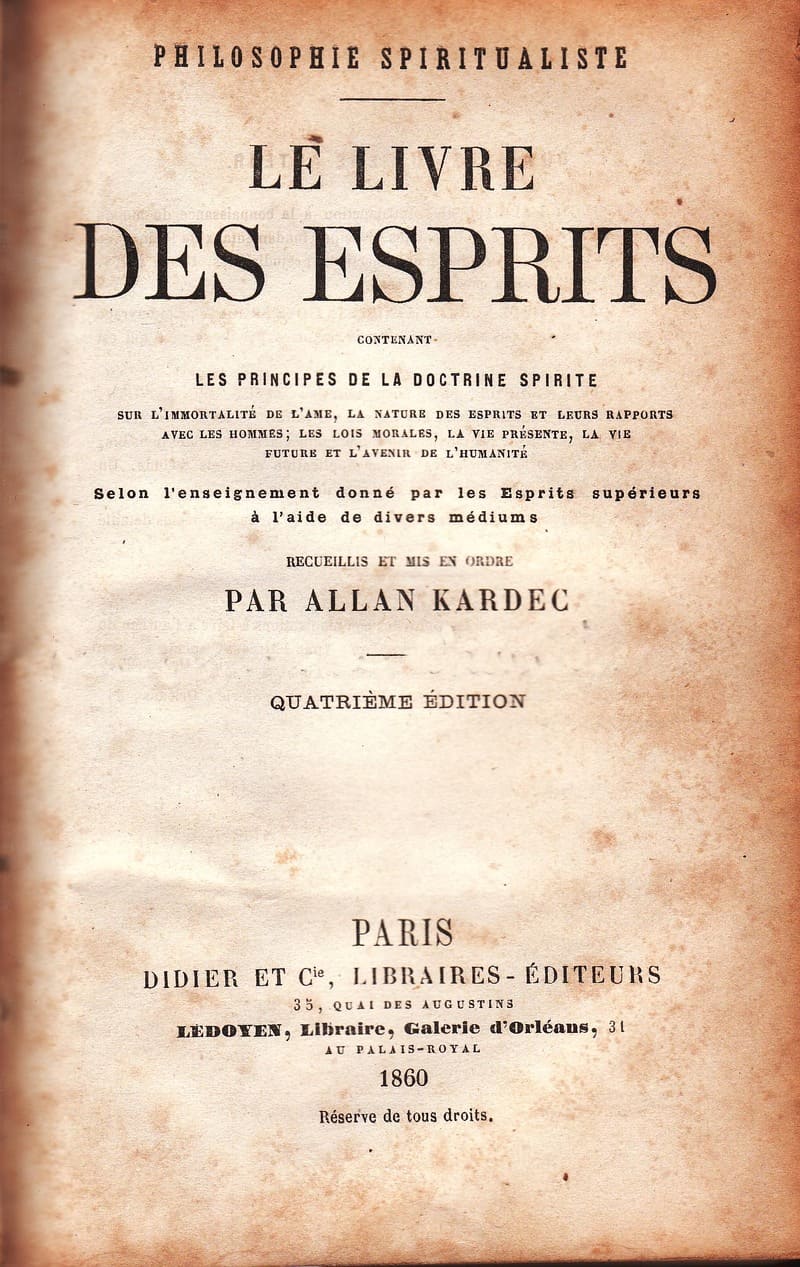
The Spirits’ Book
Historical French title page.
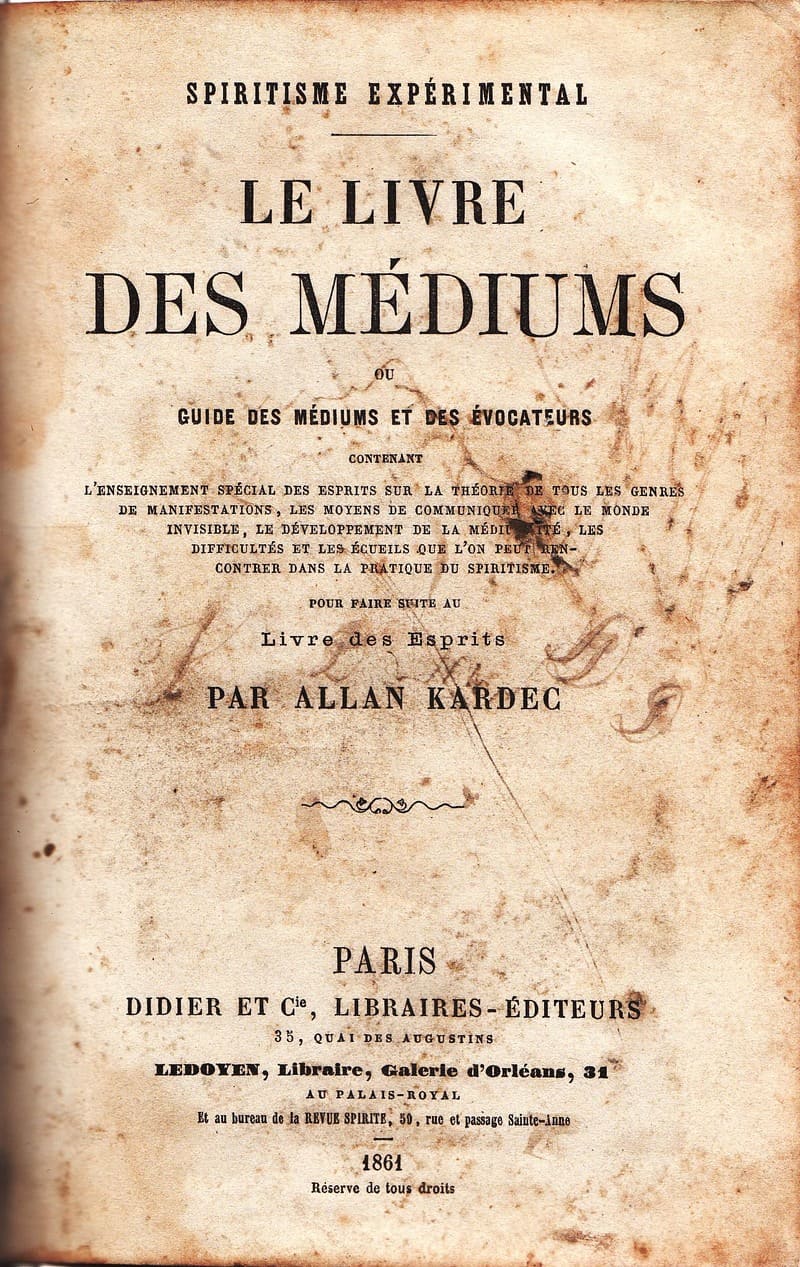
The Mediums’ Book
Historical French title page.
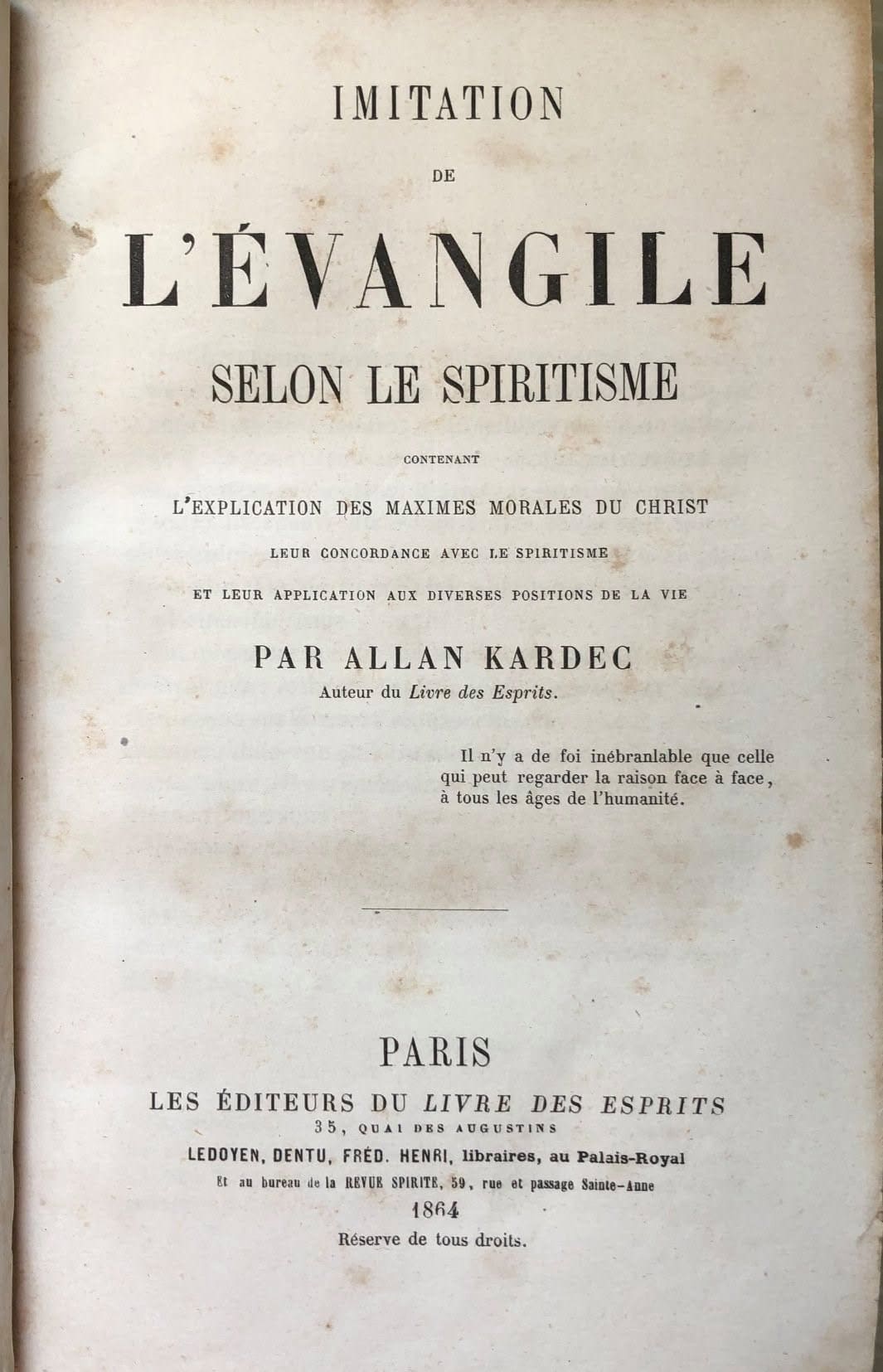
The Gospel According to Spiritism
Historical French title page.
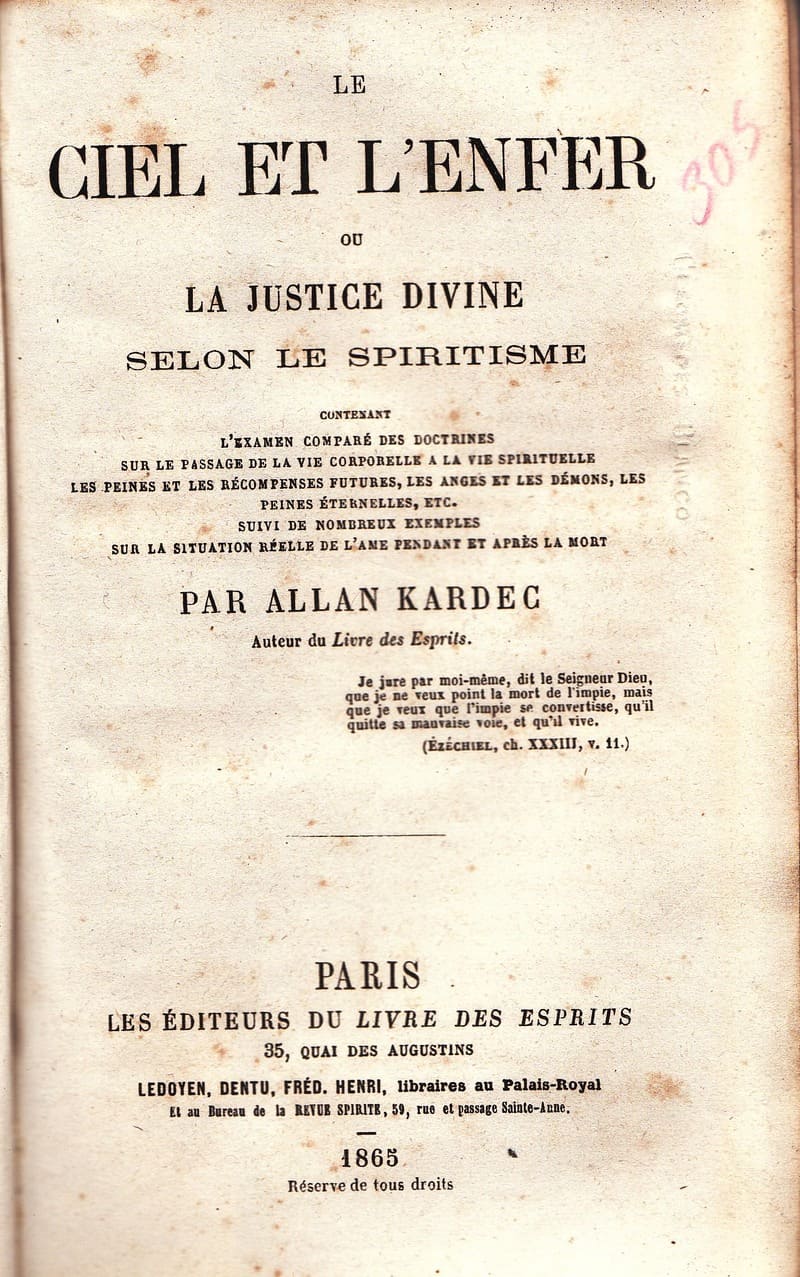
Heaven and Hell
Historical French title page.
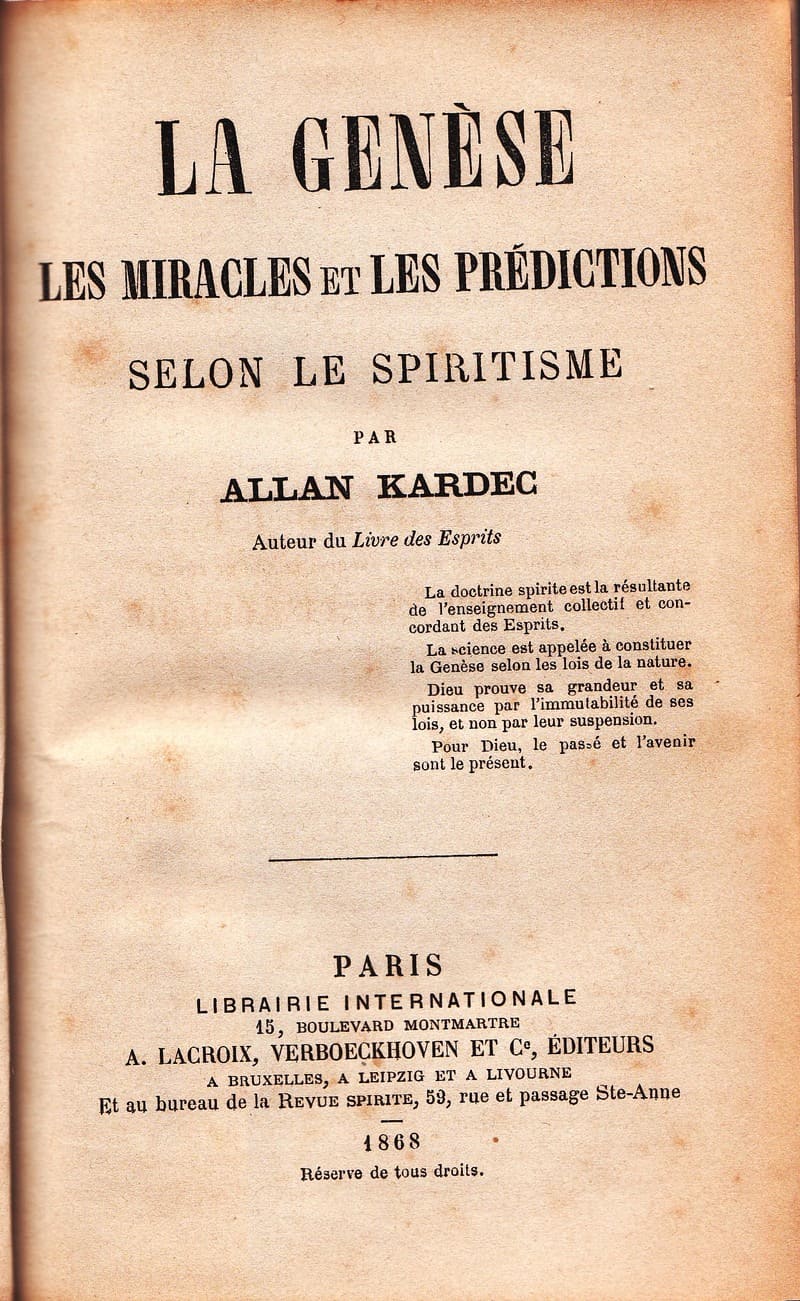
Genesis
Historical French title page.
Central teachings
Kardec’s thought is built around several central ideas. These ideas should not be isolated from one another, because they form a coherent whole.
The survival of the soul
For Kardec, death does not destroy the person. The physical body dies, but the spirit survives with its individuality, memory, tendencies and moral state. Death is therefore a transition, not annihilation.
The spirit world
Spiritism teaches that the invisible world is not a distant fantasy, but a real dimension of existence. Spirits continue to think, feel, learn and act. The spiritual world interacts with the material world, although this interaction is usually hidden from ordinary perception.
The perispirit
Kardec used the concept of the perispirit to explain the connection between spirit and matter. The perispirit is the semi-material envelope of the spirit. It links the soul to the physical body during incarnation and remains with the spirit after death.
This idea became important for explaining apparitions, impressions, spirit manifestations, certain physical phenomena, spiritual influence, obsession and the continuity of personal identity after death.
Reincarnation and progress
One of Kardec’s central teachings is that the spirit evolves over many existences. A single earthly life is not enough to explain the inequalities, trials and moral differences among human beings. Reincarnation allows the spirit to learn, repair, develop and continue its journey toward perfection.
The purpose of life is therefore not only to believe, but to progress. True progress is not only intellectual. It is moral. Pride, selfishness, cruelty and attachment to matter delay the spirit, while humility, charity, justice and love lead it forward.
The plurality of inhabited worlds
Kardec also taught the plurality of worlds: the idea that Earth is not the only inhabited world in the universe. In Spiritism, different worlds correspond to different degrees of material and moral development, and spirits may incarnate in environments suited to their progress.
This teaching expanded the moral horizon of Spiritism. Human life on Earth was not seen as the center of creation, but as one stage within a much larger spiritual universe.
Moral law
For Kardec, the universe is governed not only by physical laws but also by moral law. Human beings are responsible for their choices. The consequences of actions continue beyond death, but divine justice is never separated from divine goodness.
Mediumship with discernment
Kardec did not treat mediumship as a sign of holiness. A medium is an intermediary, not necessarily a morally superior person. Because spirits differ greatly in moral and intellectual development, communications must be examined carefully.
This is one of Kardec’s important warnings. Not all spirits are truthful. Not all impressive communications are elevated. The moral content of a message matters more than mystery, style or emotional effect.
Heaven and Hell and spiritual justice
Heaven and Hell is one of Kardec’s important moral works because it directly challenges the idea of eternal damnation. Kardec did not accept hell as a fixed place of endless punishment. He understood suffering after death as a condition of the spirit itself, shaped by remorse, attachment, ignorance and moral imperfection.
This was a radical shift in moral perspective. In Kardec’s view, punishment is not eternal revenge. It is educational, proportionate and temporary. The suffering of a spirit lasts only as long as the causes of that suffering remain active in the spirit’s own conscience and moral state.
This idea is central to Spiritist justice. God is not presented as a tyrant who condemns forever, but as supremely just and good. Every spirit remains capable of repentance, repair and progress. Even the most unhappy spirit is not outside hope.
For this reason, Heaven and Hell is not only a book about the afterlife. It is a book about moral responsibility. It teaches that the future life reflects what a person has made of themselves, while still preserving the possibility of transformation.
Spiritism vs. Spiritualism
The terms Spiritism and Spiritualism are often confused, but they do not mean exactly the same thing.
Modern Spiritualism developed especially in the English-speaking world after the events associated with the Fox sisters in 1848. It emphasized communication with the dead, public séances, physical phenomena and evidence for survival after death.
Spiritism, as codified by Allan Kardec, accepted spirit communication but placed it inside a broader philosophical and moral system. Its central doctrines include reincarnation, moral progress, the plurality of inhabited worlds, the perispirit, and the responsibility of the spirit across multiple lives.
The key difference is reincarnation. Anglo-American Spiritualism often accepted survival after death without making reincarnation central. Kardec’s Spiritism made reincarnation one of the foundations of divine justice and spiritual progress.
Spiritism also differs in tone. Kardec tried to move the subject away from spectacle and toward study. Table-turning and physical phenomena were important historically, but they were not the goal. For Kardec, the purpose of spirit communication was moral instruction and a clearer understanding of life, death and human destiny.
Church, theology and Spiritist critique
Kardec’s relationship with Christianity was complex. He treated the moral teachings of Jesus with deep respect, especially charity, humility, forgiveness and love of neighbor. At the same time, he rejected several dogmas of traditional Christianity, including eternal damnation, the literal understanding of hell, the exclusive authority of priesthood and the idea of miracles as violations of natural law.
For Kardec, Spiritism was not meant to destroy religion, but to reinterpret spiritual truth through reason, moral law and the continuity of life after death. This placed him in direct tension with Catholic theology, especially in countries where the Church still strongly influenced education, public morality and the interpretation of the afterlife.
The conflict was not only doctrinal. It was also cultural. Spiritism offered ordinary people a way to think about death, suffering and divine justice without relying entirely on ecclesiastical authority. This explains why it attracted interest among some readers and strong opposition from others.
Kardec’s critique of dogma was therefore inseparable from his moral project. He wanted faith to be rational, progressive and compatible with divine justice. In his view, a belief that contradicted reason or goodness could not represent the highest form of spiritual truth.
Opposition and controversy
Kardec’s work did not appear in a neutral environment. Nineteenth-century France was marked by intense debates about science, religion, materialism, Catholic authority, secular education, magnetism, psychology and the limits of reason.
Spiritism challenged several groups at once. It challenged materialists by defending the survival of the soul. It challenged religious orthodoxy by interpreting spirits, heaven, hell, angels, demons and miracles in a rational and progressive way. It challenged careless spiritual enthusiasts by insisting on method, moral discipline and discernment.
Kardec and Spiritism were criticized by skeptics, clergy, physicians and intellectual opponents. Critics argued that mediumistic phenomena could be explained by fraud, suggestion, hallucination, mental automatism, unconscious activity or social contagion. Kardec himself acknowledged the need to distinguish genuine spirit communication from error, imagination and deception.
There were also tensions inside the broader spiritualist world. Some critics argued that Kardec became too doctrinal, especially on reincarnation. Others felt that his preference for written communications and moral teachings gave less importance to physical mediumship and experimental phenomena.
This critical dimension should not be hidden. It is part of what makes Kardec historically important. His work was not simply an act of belief; it was an attempt to create a rational framework for phenomena that many others either sensationalized or dismissed.
Travels and the spread of Spiritism in France
From the early 1860s, Kardec’s work increasingly involved travel, correspondence and public contact with Spiritist groups. Spiritism was no longer limited to Parisian circles. It spread into cities such as Lyon, Bordeaux, Tours, Orléans and others.
Lyon was especially important. It was Kardec’s birthplace and became one of the major centers of early French Spiritism. Reports from the period describe rapid growth among readers and study groups. The movement did not remain confined to intellectual elites; it also reached workers and people seeking moral consolation.
Kardec’s travels were not glamorous lecture tours in the modern sense. They were part of the practical labor of organizing a new movement: meeting groups, encouraging serious study, correcting misunderstandings and reinforcing the moral direction of Spiritism.
He repeatedly warned that Spiritism should not become a mere search for phenomena. Its value, in his view, depended on moral transformation. The true Spiritist was not the person most fascinated by manifestations, but the person who tried to become better.
Reception beyond France and Brazil
Although Brazil became the most visible center of Kardecist Spiritism, Kardec’s influence was never limited to France and Brazil. In the nineteenth century, his books and ideas also circulated in Spain, Portugal, Italy and parts of Latin America, where French intellectual culture and Catholic debates created fertile ground for Spiritist discussion.
Spain is especially important because of the Barcelona Auto-da-fé, but interest in Spiritism there was not limited to persecution. Spanish Spiritists translated, debated and organized around Kardecist ideas. Portugal also became significant because of linguistic and cultural links that later helped connect Portuguese-speaking Spiritist networks with Brazil.
In Italy, Spiritist and psychical debates also developed in conversation with wider European currents. Writers and investigators such as Luigi Capuana and Ercole Chiaia belong to this broader Italian context of mediumship, psychical inquiry and spiritual debate, even when their work should not be reduced simply to Kardecist doctrine.
In Asia, the Philippines later became one of the notable centers where Kardecist Spiritism developed through study groups, translations and organized institutions. This shows that Kardec’s influence was not only a French or Brazilian phenomenon, but part of a wider international network of readers and Spiritist communities.
In the English-speaking world, the situation was different. Britain and the United States developed strong Spiritualist movements, but these movements did not generally adopt Kardec’s doctrine with the same intensity. Communication with the dead, public mediums and physical phenomena were often more central than reincarnation, the perispirit and the full Kardecist codification.
The difference helps explain why Kardec is a major name in Latin Spiritist cultures but a less familiar figure in many English-language histories of Spiritualism. The phenomena overlapped, but the doctrinal systems did not develop in the same way.
The Barcelona Auto-da-fé
One of the most dramatic episodes in the early history of Spiritism was the Barcelona Auto-da-fé of 1861. Spiritist books sent to Spain were seized and publicly burned by order of ecclesiastical authority.
The event was meant as an act of condemnation. Paradoxically, it gave Spiritism greater visibility. For Kardec and his supporters, the burning of books showed that the movement had become important enough to be opposed publicly.
The episode also strengthened the image of Spiritism as a movement caught between religious authority and modern claims of freedom of conscience. For readers today, it is one of the clearest signs that Kardec’s work was not only a private spiritual curiosity; it had entered the public and ideological conflicts of nineteenth-century Europe.
Napoleon III and political interest
Spiritist and biographical accounts report that Napoleon III showed interest in spirit phenomena and in Kardec’s work. The political and cultural world of the Second French Empire was not indifferent to these questions. Spiritualism, magnetism and psychical phenomena attracted curiosity in both popular and elite circles.
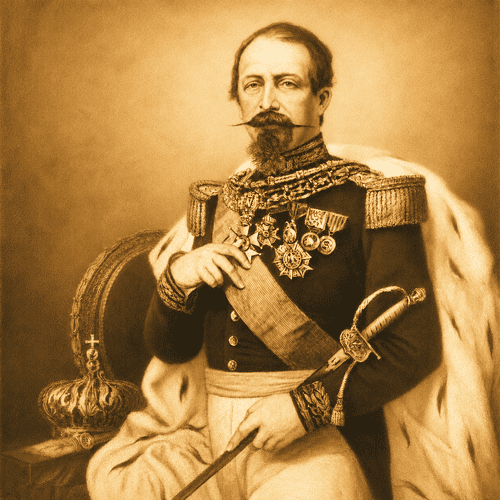
Napoleon III
Napoleon III ruled France during the period in which Kardec’s Spiritist work became publicly visible. His presence here is not meant to make him a Spiritist authority, but to place Kardec’s activity within the cultural and political atmosphere of the Second French Empire.
Reports of imperial interest are historically significant because they show that Kardec’s work was not confined to marginal circles. Spirit phenomena were discussed in salons, newspapers and influential social environments. The Tuileries and the broader world of the Second Empire formed part of the cultural background in which these questions circulated.
Specific details about private conversations should still be treated with care, but the larger point is clear: Kardec’s Spiritism entered public life. Its audience included ordinary readers, educated professionals, writers, scientists and people connected with the upper classes.
D. D. Home and the debate over reincarnation
Daniel Dunglas Home, one of the most famous physical mediums of the nineteenth century, represents an important contrast with Kardec. Home was known for dramatic physical phenomena, while Kardec focused more strongly on written communications, moral teachings and doctrinal coherence.
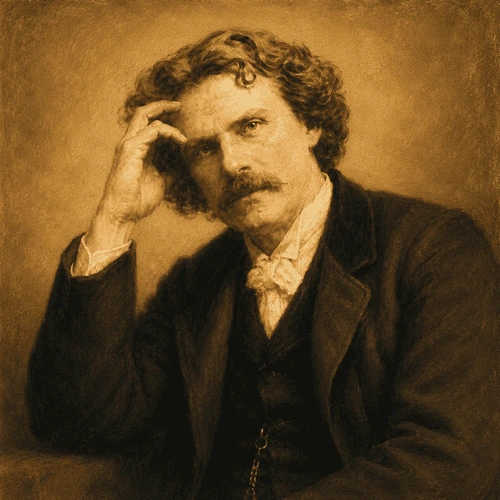
Daniel Dunglas Home
Daniel Dunglas Home was one of the most famous physical mediums of the nineteenth century. He offers a useful contrast with Kardec: Home was associated with striking phenomena, while Kardec became known for comparison, interpretation and doctrinal organization.
A major tension concerned reincarnation. Home rejected reincarnation, while Kardec considered it a central principle of Spiritism. This disagreement shows that the world of spirit communication was not unified. Different spiritualist currents drew different conclusions from similar phenomena.
For Kardec’s supporters, his insistence on reincarnation was part of a coherent moral system. For critics, it showed that he could be too doctrinal and that he sometimes gave priority to teachings that confirmed his framework.
The tension is historically useful because it prevents a simplistic portrait of Kardec as merely “the founder of spirit communication.” He was not simply recording phenomena. He was selecting, interpreting and systematizing them within a specific philosophical doctrine.
Science, psychology and psychical research
Kardec repeatedly framed Spiritism as something that should not fear reason. He argued that spirit phenomena, if real, must belong to natural law rather than to the supernatural in the sense of lawless miracle.
This placed him near several debates that later became important to psychology, psychiatry and psychical research. Questions about trance, automatism, hallucination, unconscious mental activity, dissociation and mediumship would continue to be discussed long after Kardec’s death.
Camille Flammarion, the astronomer and writer, remained associated with spiritual and psychical questions and gave a famous funeral oration for Kardec. Charles Richet, later a Nobel Prize winner in medicine, also recognized Kardec’s importance for the development of metapsychical research, even though later psychical research did not simply reproduce Kardec’s conclusions.
Pierre Janet is relevant because his work on psychological automatism and dissociation helped shape later explanations of trance and mediumistic behavior. Théodore Flournoy studied mediumship and unusual psychological states from the standpoint of emerging psychology. Frederic W. H. Myers and William James also helped place mediumship, survival and religious experience within broader debates about consciousness.
These later thinkers did not simply accept Kardec’s conclusions. Their importance is different: they show that the phenomena Kardec studied became part of a larger intellectual history of psychology, psychical research and the study of the unconscious.
His approach also anticipated a major modern issue: how should one study experiences that are meaningful to witnesses but difficult to verify under ordinary scientific conditions? Kardec’s answer was comparison, repetition, moral evaluation and the careful separation of fact from interpretation.
Criticism and historical limits
A strong profile of Kardec should not hide the limits of his century. His works were written in nineteenth-century Europe, a world shaped by colonial assumptions, racial theories, hierarchical anthropology and confidence in European progress. Some passages in Kardecist literature reflect that historical atmosphere and should be read critically today.
This does not erase the universal moral core of Spiritism, especially its emphasis on the immortality of the soul, reincarnation, moral progress, charity and the equal destiny of all spirits. But it does mean that modern readers should distinguish between the enduring principles of the doctrine and the period language through which some ideas were expressed.
Another important controversy concerns later attempts to reinterpret Spiritism in more mystical or theological directions. The Roustaing controversy, especially influential in parts of the Brazilian debate, shows how difficult it was to define the boundaries of Kardecist orthodoxy after Kardec. The issue was not only personal rivalry; it concerned the meaning of Christ, the nature of incarnation and the authority of the codification.
For readers today, these controversies are useful because they prevent an idealized view of the movement. Kardec’s legacy includes a powerful doctrine, but also debates about evidence, interpretation, historical context and institutional authority.
Kardec in his own words
A profile of Kardec is incomplete without at least a brief sense of his own voice and the phrases associated with his legacy.
“I have always preferred that which speaks to the intelligence over that which only speaks to the imagination.”
This phrase is often attributed to Kardec in Spiritist biographical tradition and captures the spirit of his method: to move from wonder to understanding, from sensation to moral and intellectual clarity.
“Unshakable faith is only that which can face reason face to face in every human epoch.”
This idea, associated with The Gospel According to Spiritism, expresses one of Kardec’s important principles: faith should not be opposed to reason, but strengthened by it.
“Naître, mourir, renaître encore et progresser sans cesse, telle est la Loi.”
Translated: “To be born, to die, to be reborn again and to progress continually: such is the law.” This phrase is best treated as the famous epitaph associated with Kardec’s tomb and later Spiritist memory, rather than as a clearly documented authorial quotation by Kardec himself. It remains one of the most concise summaries of the Spiritist idea of reincarnation and moral progress.
The film Kardec and historical accuracy
The film Kardec presents a dramatic version of Rivail’s transformation into Allan Kardec. It highlights several meaningful themes: Rivail as a respected teacher, his skepticism toward spirit phenomena, his concern with education, the pressure of religious authority, the skepticism of academic circles and the strength of his marriage to Amélie Gabrielle Boudet.
These themes are useful for understanding Kardec’s personality, but they should be handled carefully in a historical profile. A film is not the same as a primary source. Some scenes may condense events, dramatize conflicts or create symbolic moments for narrative effect.
For example, the film’s emphasis on Kardec as a teacher who resisted rigid or religiously controlled education reflects an important tension of the time, but specific scenes should not automatically be treated as documented fact. Likewise, dramatic moments involving authorities, accusations or political hesitation should be presented as film interpretation unless supported by independent sources.
The safest and most accurate approach is to say that the film captures real historical tensions around Kardec: education, religious authority, scientific skepticism, social controversy and the difficulty of bringing Spiritism into public debate.
Final years and plans for the future of Spiritism
Kardec’s final years were marked by intense work, declining health and concern for the future of Spiritism after his death. He was not only writing books. He was also thinking institutionally.
After publishing Genesis in 1868, he worked on plans for a new organization that would give Spiritism more stability and continuity. The idea was to create a legal and publishing structure capable of continuing the work, managing the periodical, books and future activities of the movement.
The detail is important. Kardec did not want Spiritism to depend only on his personal presence. He understood that a doctrine, if it was to survive, needed organization, publishing, continuity and responsible administration.
Biographical sources also describe his interest in Villa Ségur, a property associated with his hopes for retirement and with the idea of a future charitable or supportive institution for those who had served Spiritism. These plans show the practical and social side of Kardec’s final concerns.
His body, however, was exhausted. The burden of letters, polemics, editorial work, meetings, doctrinal organization and public responsibility had taken a toll. Spiritist tradition remembers him as working until the end.
Death and tomb at Père Lachaise
Allan Kardec died in Paris on 31 March 1869. Biographical tradition commonly attributes his death to the rupture of an aneurysm. He died suddenly, while still engaged in work connected with the future organization of Spiritism.
The news of his death was a shock for the young Spiritist movement. Kardec had been not only an author, but also an editor, organizer, correspondent and point of doctrinal reference. His passing immediately raised the question of continuity: who would preserve the work, the periodical, the publishing activity and the unity of the movement?
Camille Flammarion, the astronomer and writer, gave a famous funeral address for Kardec. This moment was symbolically important because Flammarion was a public scientific figure, not simply an internal administrator of the Spiritist movement. His presence gave the funeral a wider intellectual resonance and helped present Kardec as a man of reason, inquiry and disciplined thought rather than merely a religious enthusiast.
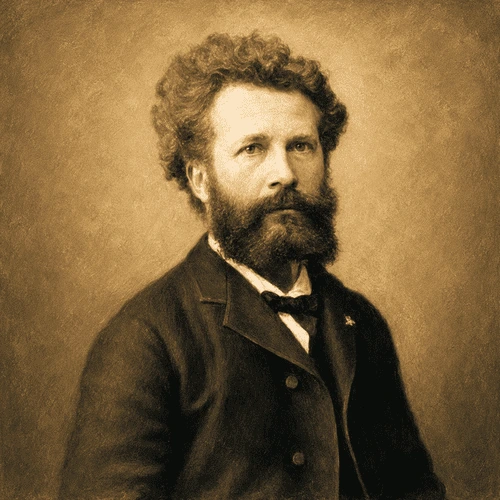
Nicolas Camille Flammarion
Nicolas Camille Flammarion was a French astronomer and writer whose presence at Kardec’s funeral gave the event a broader intellectual resonance. His name connects Kardec’s legacy with the nineteenth-century search for dialogue between scientific inquiry and spiritual questions.
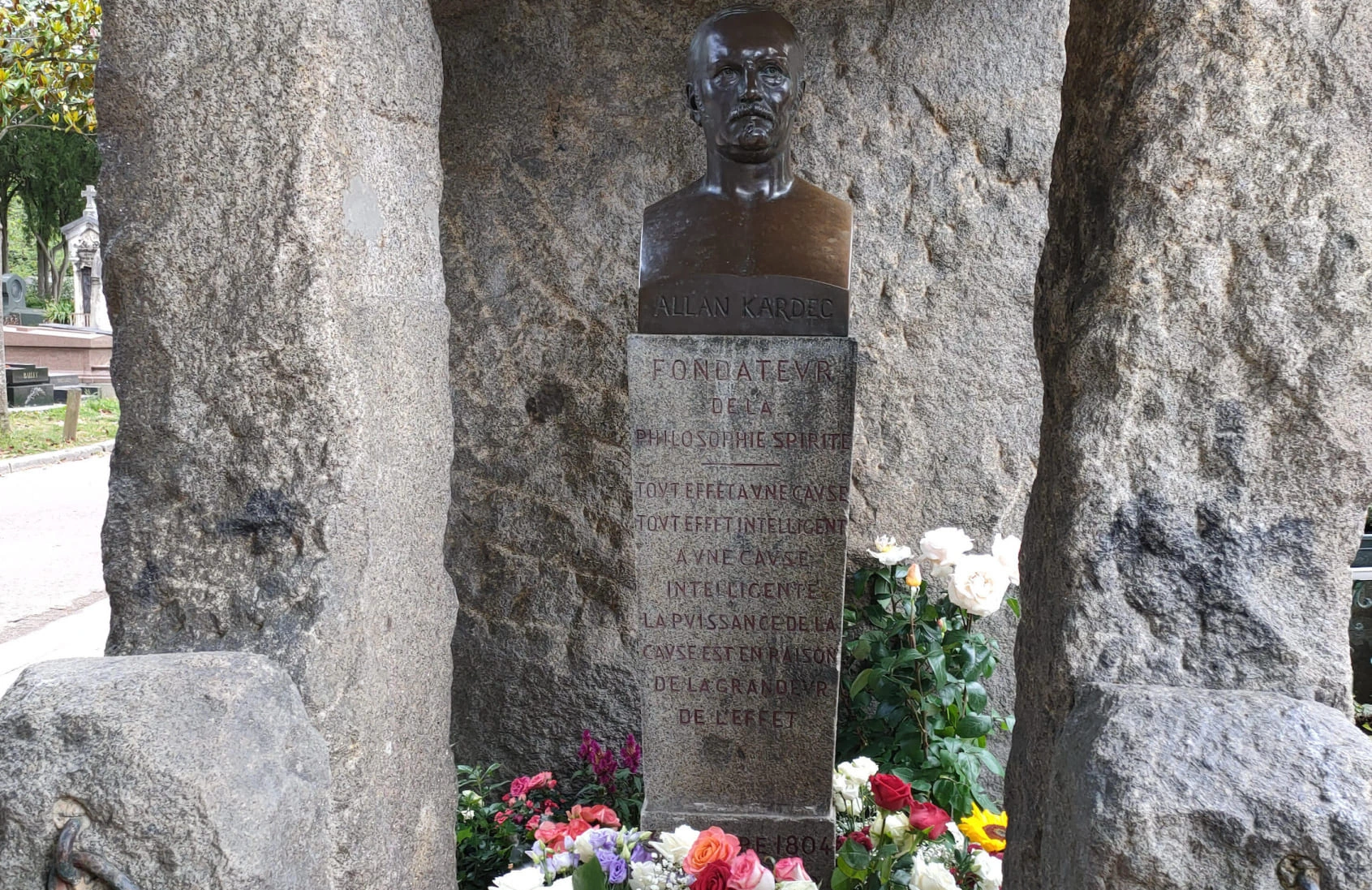
His tomb at Père Lachaise Cemetery in Paris became one of the most recognizable Spiritist memorials in the world. Its form is especially significant: it resembles a dolmen, a structure associated with ancient stone monuments and often interpreted in relation to the druidic symbolism connected with the name Allan Kardec.
The tomb includes a bronze bust of Kardec by Paul-Gabriel Capellaro. It is also associated with the famous Spiritist phrase: “Naître, mourir, renaître encore et progresser sans cesse, telle est la Loi.” This inscription summarizes the Spiritist idea of reincarnation and moral progress, but it should be understood as an epitaph and traditional summary rather than a securely documented quotation written by Kardec himself.
Another inscription on the monument expresses a key logical principle of Kardec’s thought: every effect has a cause, every intelligent effect has an intelligent cause, and the power of the cause is measured by the magnitude of the effect. This reflects the reasoning by which Kardec approached spirit phenomena: intelligent effects, he argued, point toward intelligent causes.
The tomb has also acquired cultural significance beyond the Spiritist community. It was officially recognized as a listed historic monument (monument historique inscrit) in 1983, under the Mérimée heritage reference PA00086780. This recognition confirms that Kardec’s memorial is not only a devotional site, but also part of France’s protected funerary and cultural heritage.
Visitors often touch the bust or leave flowers, a practice linked to devotional memory and popular tradition. A widespread legend says that touching the bust while making a wish brings help or good fortune. Whether or not one accepts such stories, the practice shows how Kardec’s memory moved from books into ritual, pilgrimage and popular devotion.

Centenary remembrance in 1904
This 1904 centenary image shows how Allan Kardec’s memory was preserved and publicly commemorated decades after his death. It presents him not only as an author, but as the founder of the Spiritist doctrine and creator of Revue Spirite.
Kardec and Spiritism in Brazil
Allan Kardec’s greatest long-term influence is arguably not in France, but in Brazil. While his name became relatively obscure in much of French public culture, his books became foundational for a major Brazilian religious, philosophical and charitable movement.
Brazil has the largest Spiritist population in the world. The 2010 Brazilian census recorded around 3.8 to 4 million self-declared Spiritists, making Spiritism one of the country’s notable religious groups after Catholicism and Evangelical Christianity. The number of people influenced by Spiritist ideas is broader than formal census identity, because many Brazilians read Spiritist literature or attend Spiritist centers without necessarily identifying exclusively as Spiritist.
Kardec is also one of the most widely read French spiritual authors in Brazil. The Brazilian Spiritist Federation and other publishers have distributed millions of copies of his works, and the circulation of Kardecist literature is far larger than what his public recognition in France might suggest.
Spiritism entered Brazil in the nineteenth century through French cultural influence, immigrants, intellectual circles, newspapers, books and early study groups. Over time, it developed into a large movement with study centers, publishing houses, hospitals, schools, charitable institutions and social assistance projects.
Brazilian Spiritism is deeply shaped by Kardec, but it also developed its own historical character. It interacted with Brazilian Catholic culture, with debates about healing and medicine, and with a wider religious landscape that included Afro-Brazilian traditions such as Umbanda and Candomblé.
It is important not to confuse these traditions. Kardecist Spiritism emphasizes study, moral progress, reincarnation, mediumship and charity within a framework based on Kardec’s works. Umbanda and Candomblé have different historical roots, rituals, cosmologies and cultural foundations, although in Brazil there has sometimes been contact, overlap or popular confusion between them.
Brazil also gave Spiritism some of its most influential later figures, especially Chico Xavier. Through books, public reputation and charitable activity, Chico Xavier helped make Spiritism a major force in Brazilian religious life. Many Brazilian Spiritists understand his work as a continuation of the studies begun by Kardec.
Chico Xavier and the Brazilian continuation
Francisco Cândido Xavier, known as Chico Xavier, lived from 1910 to 2002 and became the most influential Brazilian Spiritist medium of the twentieth century. If Kardec codified the doctrine, Chico Xavier helped carry it into the daily religious imagination of millions of Brazilians.
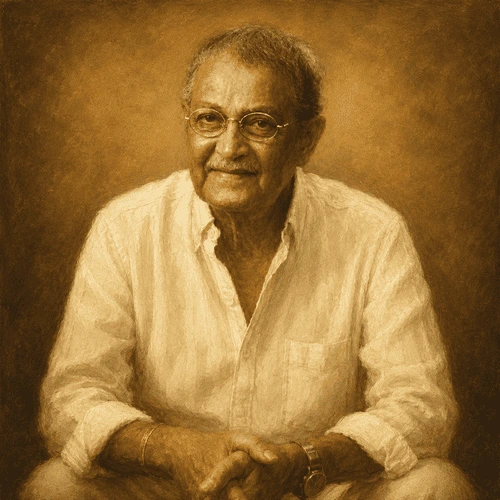
Francisco Cândido Xavier
Francisco Cândido Xavier, widely known as Chico Xavier, became the most influential Brazilian Spiritist medium of the twentieth century. His public life, charitable reputation and large body of psychographed literature helped make Kardec’s doctrine a living cultural force in Brazil.
Xavier became known for psychographed books, spiritual messages and a public life marked by humility, charity and emotional connection with ordinary people. He is traditionally associated with more than 400 psychographed books, many of them translated into multiple languages, covering themes such as the afterlife, family consolation, moral responsibility, spiritual education and the continuity of life after death.
For many Brazilian Spiritists, Chico Xavier did not replace Kardec. He extended the reach of Kardec’s framework. His books and public presence helped transform Spiritism from a doctrine studied in circles and centers into a large-scale cultural and religious phenomenon.
For this reason the Brazilian story is essential to any complete profile of Kardec. Kardec’s ideas might have remained a nineteenth-century French movement. Through Brazil, they became a living international tradition.
Successors and later influence
Kardec’s death did not end Spiritism. His work was continued, interpreted and expanded by later authors, mediums and organizers.
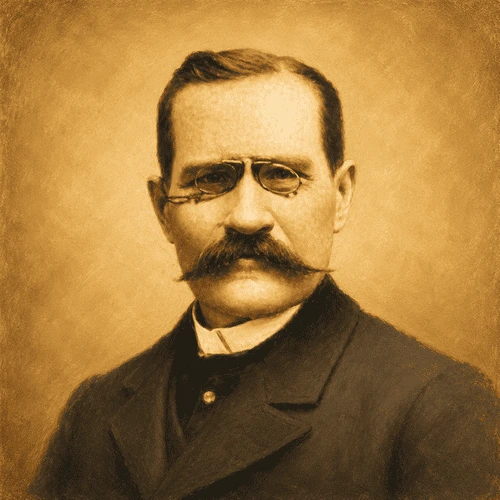
Léon Denis
Léon Denis helped develop the philosophical and moral dimensions of Spiritism after Kardec. He became one of the important voices in presenting Spiritism as a doctrine of spiritual progress, responsibility and inner transformation.
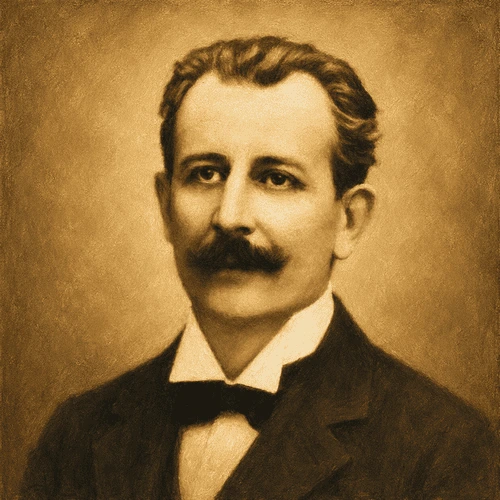
François-Marie Gabriel Delanne
François-Marie Gabriel Delanne emphasized the scientific and experimental side of Spiritist inquiry. His work continued one of Kardec’s central concerns: that spiritual phenomena should be approached with observation, comparison and disciplined reasoning.
- Léon Denis helped develop the philosophical and moral dimensions of Spiritism after Kardec.
- Gabriel Delanne emphasized the scientific and experimental side of Spiritist inquiry.
- Camille Flammarion, the astronomer and writer, remained associated with psychical and spiritual questions and gave a famous funeral oration for Kardec.
- Chico Xavier became the most influential Brazilian Spiritist medium of the twentieth century, producing a vast body of psychographed literature.
- Divaldo Pereira Franco became one of the best-known contemporary Spiritist speakers, educators and mediums.
These figures did not simply repeat Kardec. They developed different aspects of the movement: philosophy, science, charity, literature, public speaking and mediumistic practice. Together, they show how Kardec’s codification became the foundation for a living tradition.
Historical facts and Spiritist tradition
A responsible profile of Allan Kardec should distinguish between documented historical facts and claims that belong to Spiritist tradition.
Historically documented elements include his birth in Lyon, his civil name, his educational career, his marriage to Amélie Boudet, his publications, the founding of Revue Spirite, the publication of the Spiritist Codification and his death in Paris in 1869.
Spiritist traditional elements include the communication about his previous druidic incarnation, the spiritual origin of the name Allan Kardec, and the idea that he had a providential mission guided by higher spirits.
This distinction does not weaken the profile. It strengthens it. It allows readers to understand Kardec both as a historical figure in nineteenth-century France and as a spiritual figure within the memory of the Spiritist movement.
Selected pre-Spiritist writings
- Cours pratique et théorique d’arithmétique
- Plan proposé pour l’amélioration de l’instruction publique
- Grammaire française classique
- Manuel des examens pour les brevets de capacité
- Catéchisme grammatical de la langue française
- Other educational manuals, translations and instructional works connected with language, arithmetic, science and moral education.
Further reading
Works by Allan Kardec
- The Spirits’ Book
- The Mediums’ Book
- The Gospel According to Spiritism
- Heaven and Hell
- Genesis
- What Is Spiritism?
- Posthumous Works
Later Spiritist authors
- Léon Denis, works on the philosophy and moral meaning of Spiritism
- Gabriel Delanne, works on the scientific and experimental study of the soul and mediumship
- Chico Xavier, psychographed works central to Brazilian Spiritism
- Divaldo Pereira Franco, lectures and mediumistic works in contemporary Spiritism
Where to find further sources
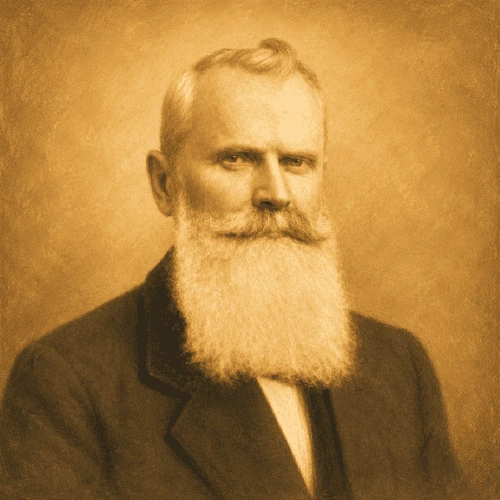
Henri Sausse
Henri Sausse wrote one of the influential Spiritist biographies of Allan Kardec. His account belongs to the internal Spiritist biographical tradition and is useful for understanding how Kardec was remembered by later adherents.
Anna Blackwell
Anna Blackwell helped introduce Kardec’s life and ideas to English-speaking readers. Her biographical preface remains important as an early English-language presentation of Kardec and the Spiritist movement.
- Henri Sausse, Biographie d’Allan Kardec, for an influential Spiritist biographical tradition.
- Anna Blackwell’s biographical preface to The Spirits’ Book, for an early English-language presentation of Kardec’s life and work.
- Revue Spirite, especially the years edited by Kardec, for reports, correspondence, doctrinal discussions and responses to critics.
- Bibliographic authority records such as BnF, VIAF and Wikidata, useful for checking names, editions, translations and library references.
- Modern academic studies on French Spiritism, Brazilian Spiritism, mediumship and psychical research, which should be consulted separately when a strictly historical or sociological perspective is needed.
Main sources
This profile is based on a combination of Kardec’s own works, early Spiritist biographical tradition, later Spiritist authors, bibliographic authority records and modern historical context. Because Allan Kardec is both a documented historical figure and a central figure in Spiritist tradition, the page distinguishes between verifiable historical elements and claims preserved within Spiritist memory.
Primary Spiritist works by Allan Kardec
- The Spirits’ Book / Le Livre des Esprits (1857)
- The Mediums’ Book / Le Livre des Médiums (1861)
- The Gospel According to Spiritism / L’Évangile selon le Spiritisme (1864)
- Heaven and Hell / Le Ciel et l’Enfer (1865)
- Genesis / La Genèse (1868)
- What Is Spiritism? / Qu’est-ce que le Spiritisme? (1859)
- Posthumous Works / Œuvres posthumes (1890)
Periodical and historical Spiritist material
- Revue Spirite, especially the years edited by Allan Kardec from 1858 to 1869.
- Historical French title pages and bibliographic material connected with Kardec’s major works.
- Spiritist documents and later editorial material related to Kardec’s publications and legacy.
Biographical and interpretive sources
- Henri Sausse, Biographie d’Allan Kardec, an influential Spiritist biographical account.
- Anna Blackwell’s biographical preface to The Spirits’ Book, important for early English-language reception of Kardec.
- Later Spiritist authors such as Léon Denis and Gabriel Delanne, who developed philosophical, moral and experimental aspects of the Spiritist movement after Kardec.
Bibliographic and historical reference points
- Bibliographic authority records such as BnF, VIAF and Wikidata, useful for checking names, dates, editions and library references.
- Modern historical and academic studies on French Spiritism, Brazilian Spiritism, mediumship, psychical research and nineteenth-century religious culture.
- Public heritage information related to Kardec’s tomb at Père Lachaise Cemetery and its cultural significance.
Common misconceptions about Allan Kardec
Misconception 1: Kardec was mainly a medium.
He is better understood as a researcher, editor and codifier. His work depended on communications received through mediums, but his role was to compare, question, organize and interpret.
Misconception 2: Spiritism is only “calling the dead.”
For Kardec, communication with spirits was not the final goal. It was a means of studying the soul, moral law, reincarnation, spiritual progress and life after death.
Misconception 3: Spiritism and Spiritualism are identical.
They overlap historically, but Kardecist Spiritism has a specific doctrinal structure, especially reincarnation, the perispirit, moral progress and the universal comparison of spirit teachings.
Misconception 4: Kardec rejected science.
Kardec rejected materialism, not reason. He believed that authentic spiritual phenomena should be studied as part of natural law, even if his method does not match modern laboratory standards.
Misconception 5: Kardec was a Theosophist.
Kardec died before the Theosophical Society was founded. Spiritism and Theosophy belong to related nineteenth-century spiritual currents, but they are distinct traditions with different sources, terminology and doctrinal structures.
Misconception 6: Kardecist Spiritism is the same as Umbanda or Candomblé.
These Brazilian traditions may sometimes be confused in popular culture, but they have different roots, rituals, cosmologies and religious practices.
Questions readers often ask about Allan Kardec
Who was Allan Kardec?
Allan Kardec was the pen name of Hippolyte Léon Denizard Rivail, a French educator and writer who codified Spiritism in the nineteenth century.
What was Allan Kardec’s real profession before Spiritism?
Before Spiritism, Kardec was known as Professor Rivail. He was a teacher, translator and author of educational works on subjects such as arithmetic, grammar, public instruction and science.
What was Pestalozzi’s influence on Allan Kardec?
Pestalozzi’s educational method shaped Rivail’s habits of observation, gradual instruction, moral education and respect for the development of the whole person. These habits later appeared in Kardec’s Spiritist method.
Was Allan Kardec a medium?
Kardec is remembered mainly as a researcher, organizer and codifier of Spiritism, not as a medium in the usual sense. He studied communications received through mediums and organized them into a coherent doctrine.
Why did Hippolyte Rivail use the name Allan Kardec?
According to Spiritist tradition, the name Allan Kardec was communicated by a spirit who said Rivail had used that name in a previous incarnation as a druid in ancient Gaul.
What is Allan Kardec’s most important book?
His most important book is The Spirits’ Book, first published in 1857. It became the foundation of Spiritism and introduced its main teachings about God, spirits, the soul, reincarnation, moral law and the afterlife.
What is the Spiritist Codification?
The Spiritist Codification is the group of major works organized by Allan Kardec, especially The Spirits’ Book, The Mediums’ Book, The Gospel According to Spiritism, Heaven and Hell and Genesis.
Did Allan Kardec believe every spirit communication?
No. Kardec repeatedly warned that spirit communications must be examined with reason, moral discernment and comparison. He taught that not all spirits are truthful or elevated.
Was Allan Kardec a Christian?
Kardec treated the moral teachings of Jesus as central, especially charity, humility and love of neighbor. However, Spiritism differs from traditional Christianity in important doctrines such as reincarnation, heaven and hell, angels, demons and the nature of miracles.
Who was Amélie Gabrielle Boudet?
Amélie Gabrielle Boudet was Kardec’s wife, a teacher and woman of culture. She supported his work during his lifetime and helped preserve his Spiritist legacy after his death.
What was Revue Spirite?
Revue Spirite was the periodical founded by Kardec in 1858. It became a public forum for Spiritist reports, doctrinal discussion, correspondence, criticism and the development of the movement.
Did Allan Kardec believe in God?
Yes. Kardec taught that God is the supreme intelligence and first cause of all things. His concept of God was philosophical and moral rather than based on church ritual or dogmatic authority.
What is the difference between Spiritism and Spiritualism?
Spiritualism usually refers to the broader movement focused on communication with the dead, especially in the English-speaking world. Spiritism, codified by Kardec, includes spirit communication but also teaches reincarnation, moral progress, the perispirit and a structured philosophical doctrine.
What is the perispirit?
In Spiritism, the perispirit is the semi-material envelope of the spirit. It links the spirit to the physical body during life and remains with the spirit after death.
What does the perispirit mean in practice?
The perispirit helps explain how the spirit connects with the body, how apparitions may occur, how spiritual influence can affect a person, and why the soul retains individual characteristics after death.
What is the plurality of inhabited worlds in Spiritism?
The plurality of inhabited worlds is Kardec’s teaching that life exists on many worlds, not only on Earth. In Spiritism, different worlds correspond to different stages of material and moral development, and spirits may incarnate in conditions suited to their progress.
Why is Allan Kardec important in Brazil?
Kardec’s works became extremely influential in Brazil, where millions of people identify as Spiritists and many more are influenced by Spiritist literature, centers and charitable institutions.
Why is Allan Kardec relatively unknown in France compared to Brazil?
In France, Spiritism remained one current among many nineteenth-century spiritual and intellectual movements. In Brazil, Kardecist Spiritism became deeply institutionalized through books, study centers, charity, healing practices and major public figures such as Chico Xavier.
How is Spiritism different from Umbanda and Candomblé?
Kardecist Spiritism is based on the works of Allan Kardec and emphasizes study, reincarnation, moral progress, mediumship and charity. Umbanda and Candomblé have different Afro-Brazilian religious roots, rituals, cosmologies and spiritual practices, although popular confusion and some cultural overlap may occur in Brazil.
Did Allan Kardec have children?
Standard biographies generally do not record confirmed surviving children of Allan Kardec and Amélie Gabrielle Boudet. Some later accounts mention children or adopted dependents, but this point should be treated cautiously unless supported by specific sources.
How did Allan Kardec die?
Allan Kardec died in Paris on 31 March 1869. Biographical tradition commonly attributes his death to an aneurysm and remembers that he died while still engaged in his work.
Is the film Kardec historically accurate?
The film Kardec is a dramatized portrayal of his life. It reflects important themes such as education, skepticism, opposition and his relationship with Amélie Boudet, but specific scenes should be treated as dramatic interpretation unless confirmed by historical sources.
Who were Allan Kardec’s main successors in Europe?
Two of the important European successors were Léon Denis and Gabriel Delanne. Denis developed the philosophical and moral side of Spiritism, while Delanne emphasized the scientific and experimental study of the soul and mediumship.
Where can researchers find Allan Kardec’s manuscripts and bibliographic records?
Researchers should begin with published primary sources such as Kardec’s books and Revue Spirite, then consult bibliographic records from institutions such as BnF, VIAF and Wikidata. Manuscripts and archival materials are not held in one simple public location, so claims about them should be checked carefully against specific catalogues and Spiritist archives.
Social ideas and moral equality
Kardec’s Spiritism also had social implications. Its doctrine of the spirit made moral identity deeper than social status, sex, wealth, nationality or race. If the true self is the spirit, then earthly categories are temporary conditions, not the final definition of a person.
This helped support a more progressive view of women than many traditional frameworks of the time. Spiritism teaches that the spirit itself has no fixed sex in the eternal sense, because it may incarnate in male or female bodies across different lives. This idea gave Kardec a philosophical basis for moral equality between men and women, even if nineteenth-century social language remained shaped by its time.
Spiritism also offered a strong language of moral justice. Suffering, inequality and social responsibility were interpreted through divine justice, free will, expiation and progress. This framework later resonated strongly in Brazil, where Spiritist circles became associated with charity, education, healing institutions and, in some contexts, reformist and abolitionist ideals.
The central moral point is that no spirit is created for privilege or eternal exclusion. All are destined to progress. This idea made Kardec’s doctrine attractive not only as an afterlife teaching, but also as a moral philosophy of human improvement.