
Emanuel Swedenborg and the Vision of the Spiritual World
Emanuel Swedenborg was a Swedish scientist, philosopher, and mystic known for his detailed descriptions of the spiritual world. Although he lived before the codification of Spiritism, his writings influenced later discussions about the soul, the afterlife, and the relationship between visible and invisible reality.
He is often seen as a precursor rather than a Spiritist author in the strict sense. What makes him important is that he tried to describe life beyond death not only as a theological belief, but as an ordered and meaningful realm with its own structure, laws, and moral logic.
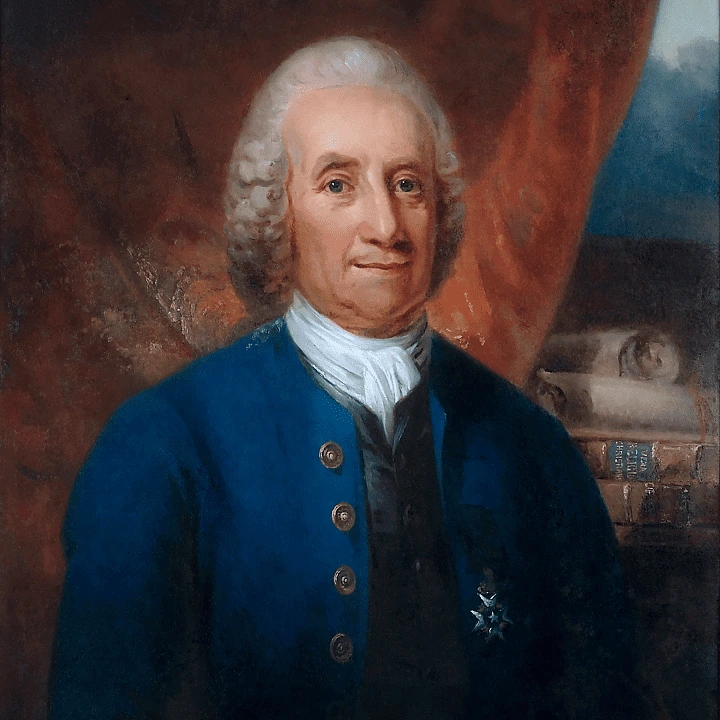
Who was Emanuel Swedenborg?
Before becoming known for his spiritual visions, Swedenborg had already established himself as a respected thinker in the fields of science, engineering, and philosophy. He worked on questions related to anatomy, physics, and cosmology, and for much of his life he was regarded as a serious intellectual figure rather than a religious visionary.
This early formation is important because it shaped the unusual character of his later work. Swedenborg did not present himself as someone escaping reason, but as someone whose understanding of reality had expanded beyond the limits of purely material explanation.
His spiritual turning point
In the later part of his life, Swedenborg began to report profound spiritual experiences. He claimed to perceive spirits, angels, and states of existence beyond physical life. These experiences led him to devote himself increasingly to describing the afterlife and the inner laws that govern it.
For Swedenborg, death did not erase individuality. The person continued to exist as the same conscious being, but now fully situated in a spiritual condition corresponding to their inner moral and mental state. This idea strongly anticipates themes later developed in Spiritist thought.
Main contribution
Swedenborg’s most important contribution was his attempt to describe the spiritual realm as an ordered reality rather than a vague mystery. He wrote about different spiritual states, the continuity of personal identity after death, and the way inner character shapes postmortem experience.
In that sense, his work resembles a map of the invisible world. He did not merely affirm that life continues after death. He tried to explain how it continues, what kind of beings inhabit that state, and why moral condition matters more than outward belief or status.
Connection to Spiritist ideas
Swedenborg was not part of Kardecist Spiritism, and he did not develop a method based on communication with spirits through organized mediumship. Even so, several of his central themes resonate with later Spiritist concepts.
Among them are the survival of the soul, the moral basis of postmortem states, and the existence of an invisible world that coexists with earthly life. His descriptions also connect naturally with ideas such as the spiritual world, the law of inner affinity, and the notion that suffering or happiness after death is related to the true condition of the being rather than to arbitrary punishment.
Why he matters as a precursor
Swedenborg matters because he stands at an important threshold between theology, mysticism, and later psychical inquiry. He was one of the earliest modern figures to describe the invisible world in a highly developed and systematic way.
Later traditions would take different paths. Some would focus on visions, some on religion, and others on mediumship or research. Swedenborg does not fit neatly into only one of these categories. That is precisely why he remains so significant: he helped make the idea of the afterlife intellectually imaginable for modern readers.
Critical perspective
Swedenborg’s accounts have often been viewed with skepticism. Critics may interpret his visions as subjective religious experience, imagination, or altered states of consciousness rather than access to an objective spiritual realm. Because of this, his writings can never be treated as neutral empirical reports in the modern scientific sense.
Yet reducing him to fantasy is too simple. His long intellectual formation, the coherence of his later descriptions, and the lasting influence of his work suggest that he occupies a more complex place in the history of thought. Even for readers who remain unconvinced by his claims, Swedenborg represents an important attempt to think seriously about survival after death.
Why Emanuel Swedenborg still matters today
Swedenborg still matters because he gave language and shape to questions that remain alive today: What survives death? Does consciousness continue? Is there a moral order beyond the visible world? Can the invisible be described in a meaningful way?
For readers interested in afterlife philosophy, spiritual anthropology, and the deeper history behind Spiritist ideas, Swedenborg remains one of the most compelling early figures. He may not belong to Spiritism itself, but he belongs to the wider genealogy of thought that made Spiritism possible.
Selected writings
- Heaven and Hell – Swedenborg’s best-known work on the structure of spiritual life after death
- Arcana Coelestia – a large theological and symbolic work interpreting spiritual meanings in scripture
- The Divine Love and Wisdom – a philosophical treatment of spiritual law, order, and divine reality